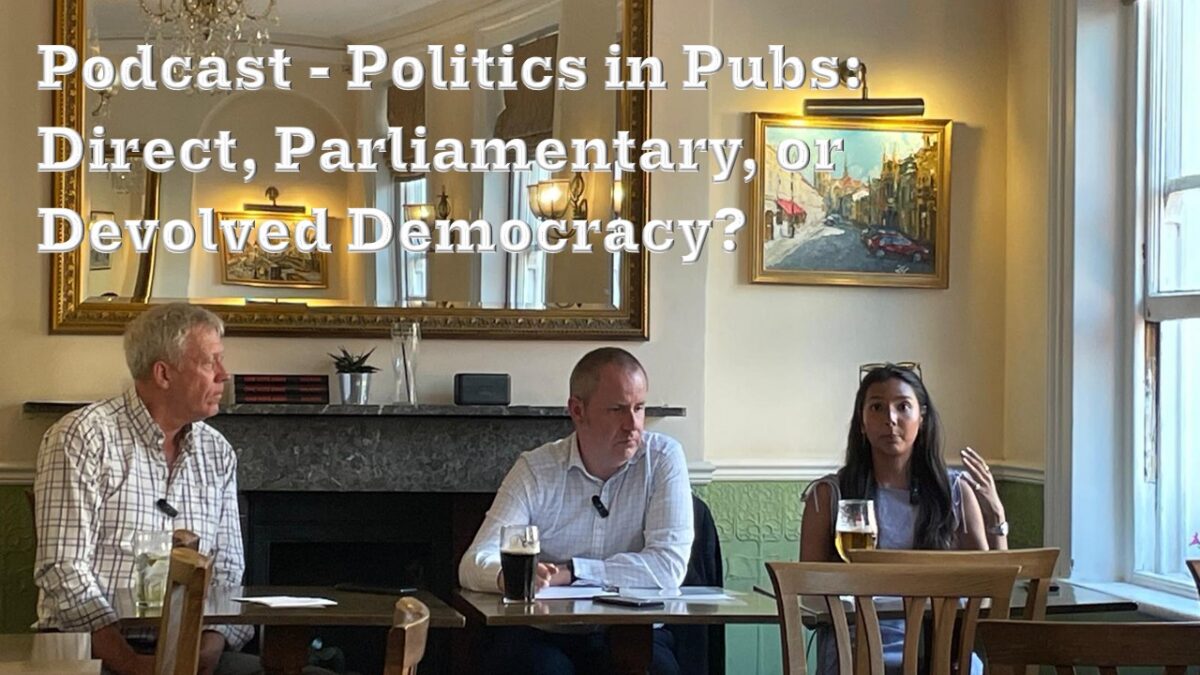
Podcast Episode 105 – Politics in Pubs: Direct, Parliamentary, or Devolved Democracy?

At the Politics in Pubs Central London event we were joined by Neil Petrie of The Direct Democracy Movement and Joanna Marchong, the new Senior Analyst and Head of Campaigns at Onward for a lively debate about the best form of democracy. https://politicsinpubs.org.uk/.

Spreaker

iTunes


Podchaser

Podcast Addict
Deezer

Spotify


Castbox

Amazon

You can find more about The Direct Democracy Movement at https://ddrightnow.com/, including details of books https://ddrightnow.com/books and videos https://ddrightnow.com/videos on the subject. Neil Petrie can be found on X at https://x.com/PetrieNeil35553.

Onward aim to set the agenda on the right, researching and creating policies to solve the problems that are making the UK poorer, the public disillusioned, and the state less effective. They can be found at https://ukonward.com/, and on Facebook and X. Joanna Marchong can also be found on X at https://x.com/marchong_joanna.

Visit Politics in Pubs at https://politicsinpubs.org.uk/ for more on their events in London and beyond. We also have a brief write up of this event below.

The Swiss model or the drawbacks we’ve seen? – Politics in Pubs in London

Against a backdrop of frequent changes of prime minister, no party polling above ~30%, rising government debt, and talk of devolution. We had two main speakers:

  • Neil Petrie (Direct Democracy Movement / board member), who strongly favours a Swiss-style semi-direct democracy.
  • Joanna Marchong (Senior Analyst and Head of Campaigns at the Onward think tank), who is more sceptical of how devolution has worked in the UK and highlighted accountability problems.

Neil Petrie’s main points:

  • The UK’s pure parliamentary/representative system is fundamentally flawed and “corrupt from the outset.” He described party whips as a “handling operation” (historically called the patronage secretary) that keeps MPs in line via patronage, with leaders themselves controlled by backers. Voters rarely feel heard.
  • Neil advocated the Swiss model (in place since 1848): a mix of representative parliament plus citizen rights to force referendums. He summarises it as the “0-1-2 system”:
    • Mandatory referendums for constitutional changes.
    • 1% of voters can trigger a referendum on new legislation.
    • 2% can launch a popular initiative (propose new ideas themselves).
  • Referendums happen several times a year (national and local). Decision-making is pushed down via subsidiarity (to cantons and communities) where possible; major issues like defence stay federal.
  • Switzerland has far lower debt-to-GDP (<40% vs UK >100%), people control the purse strings and therefore spend more carefully than politicians, and the country uniquely has nuclear shelters for its entire population (~9 million). He references US state-level initiatives (e.g. California) and the book Let the People Rule as supporting evidence that voters are more fiscally responsible than legislators.
  • Brexit was a rare positive example of (limited) direct democracy. He has long supported the idea (via the Referendum Party, UKIP, etc.) and notes Nigel Farage has praised the Swiss system.

Joanna Marchong’s main points:

  • Joanna agrees trust in politics and turnout are at historic lows and that people want to feel heard, but argues that simply moving power closer to people (devolution or more referendums) does not automatically improve outcomes.
  • UK devolution evidence is poor after 25 years in Scotland and Wales:
    • Scottish education was among Europe’s best in 1999; maths scores are now below the England average and at OECD levels.
    • Crime remains high; drug deaths are far worse than the European average (roughly four times the level when Trainspotting came out).
    • A&E waiting times that are linked to hundreds of avoidable deaths per year.
    • Per-capita funding has been higher than in England, yet results have deteriorated.
  • True devolution requires both the power to spend and full accountability for failure (no automatic Westminster bailouts). Many current UK metro-mayor and council arrangements lack this; some (e.g. Andy Burnham in Greater Manchester) have delivered visible successes such as bus fares, while newer or less experienced ones struggle with budgets, ring-fenced spending, social care, SEND, etc. Examples of heavily indebted councils (Birmingham and others) illustrate the problem.
  • Referendums have drawbacks: they “unbundle” issues that should be traded off together (e.g. “more NHS spending?” gets a yes; “higher taxes?” gets a no). Simple binary questions ignore complexity and can lock governments into conflicting mandates for years (as seen in California). Parliament’s job, done properly, is to package competing public preferences into coherent budgets and policy. The current system fails at this, which is why people demand referendums, but switching wholesale risks worse outcomes.
  • Cultural and institutional differences mean Swiss or US models do not transplant easily to the UK. Any serious devolution needs stronger local capacity, genuine fiscal responsibility, and clearer national-local boundaries.

The discussion was lively and civil. Neil repeatedly stresses that giving citizens veto/initiative power produces more sensible, lower-debt outcomes. Joanna repeatedly stresses evidence of under-performance under existing UK devolution and the practical difficulties of pure direct democracy.  We took a short break for drinks, followed by an audience Q&A.
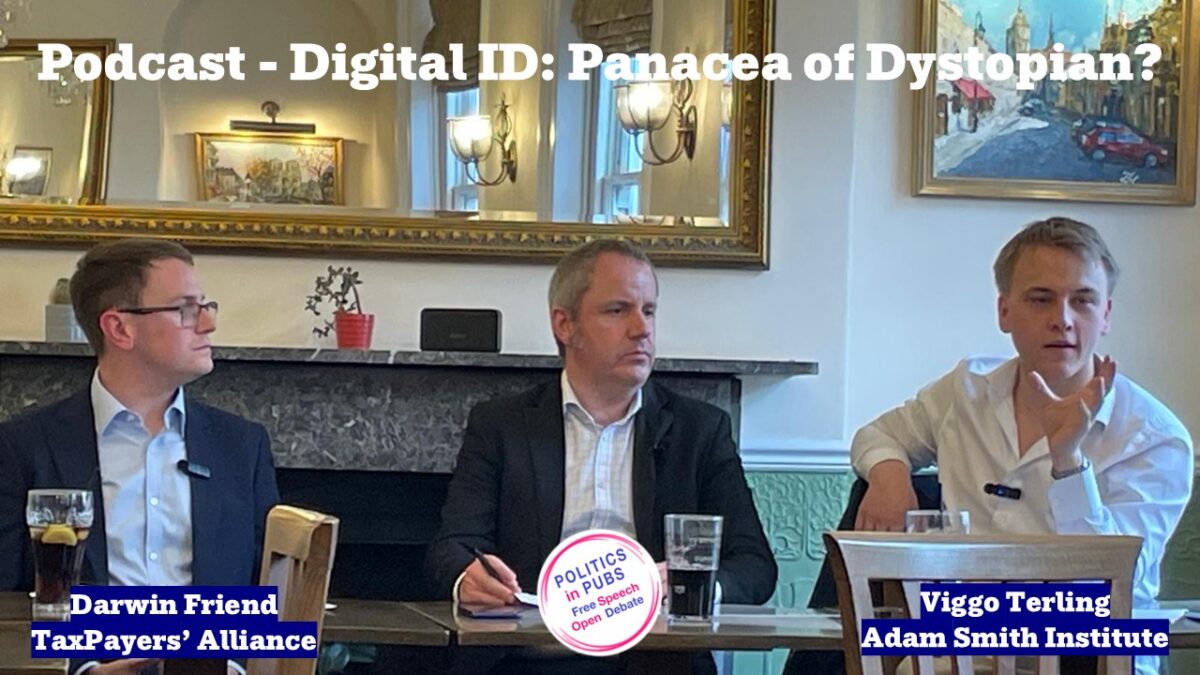
Podcast Episode 104 – Politics in Pubs: Digital ID: Panacea or Dystopia?

At the Politics in Pubs Central London event we were joined by Viggo Terling of the Adam Smith Institute, and Darwin Friend of the TaxPayers’ Alliance, for a discussion about Digital ID and whether it will prove to be a panacea or a dystopia, and what if anything we can do about it.

Spreaker

iTunes


Podchaser

Podcast Addict
Deezer

Spotify


Castbox

Amazon

Visit Politics in Pubs at https://politicsinpubs.org.uk/ for more on their events in London and beyond. We also have a brief write up of this event below.

Mixed Panacea and Dystopia: Digital ID – Politics in Pubs in London

The discussion centred on whether a UK digital ID system would be a productivity-boosting modernisation or a costly, trust-eroding government overreach. The timing of the event allowed it to be framed against the day’s news of the proposed under-16 social media ban (requiring age verification) and broader concerns about data, trust, and liberty.

Viggo Terling was broadly supportive of well-designed digital ID, strongly prefers private-sector model.  He strongly criticised the government’s nanny-state tendencies (e.g., the under-16 ban) but sees huge potential in digital verification.  Viggo advocated the Swedish BankID model, created and funded by banks (not taxpayers), voluntary but near-universally adopted (~99% of adults), used for signing mortgages, loans, government services, etc., via facial scan on a phone or card. 

Darwin Friend was sceptical, especially of government-led schemes.  He opposes mandatory or government-run digital ID due to broken public trust, history of failed projects, and cost overruns.  Darwin noted past ID card scheme under Blair wasted £4.6 billion before being scrapped. Darwin also identified the under-16 social media ban + age verification as a “slippery slope”/precursor to broader digital ID and data consolidation.

Both strongly agreed private-sector, voluntary systems are preferable and that data privacy, cybersecurity, and operational security are real issues.

Darwin’s advice for opponents: Arm yourself with facts (e.g., Big Brother Watch), resist publicly, support parties opposing it, and keep making the case.  Viggo advised people to be proactive, lobby to improve the design rather than just oppose. Focus on benefits (productivity, convenience) alongside risks.

We have a civil, thoughtful debate between two broadly libertarian-leaning speakers.  Both highlighted that how digital ID is implemented (government vs private, mandatory vs voluntary) matters far more than whether it exists in principle. The event ended with audience Q&A after a break.

Podcast Episode 103 – Politics in Pubs: Slaying the Stagnation Dragon

At the inaugural Politics in Pubs Central London event we were joined by Benjamin Elks of the Taxpayers’ Alliance and Alastair Mellon of the SDP for a discussion on how we achieve genuine, sustainable economic growth.

Spreaker

iTunes


Podchaser

Podcast Addict
Deezer

Spotify


Castbox

Amazon

Visit Politics in Pubs at https://politicsinpubs.org.uk/ for more on their events in London and beyond. We also have a brief write up of this event below.

Dragon Slayed – Politics in Pubs in London

On the 30th April Politics in Pubs made its central London debut at The Warwick in Pimlico.  We were joined by Alistair Mellon of the SDP, a civil engineer, property developer, and former SDP candidate, and Benjamin Elks the Grassroots Development Manager for the Taxpayers’ Alliance.

The event featured a panel discussion with our two guests on the theme ” Slay the Stagnation Dragon: Ignite Real Economic Growth!”, followed by audience Q&A. 

The panel discussion started with a diagnosis of the problems we face.  Alistair discussed how productivity is everything and we have major drags on the economy like sky-high energy prices and chronically low public/private investment in R&D and infrastructure. Ben talked about high taxes and spending being the core problem. Average household lifetime tax burden is now greater than £1.2 million. Taxing work/investment reduces both. He also said Welfare spending projected at £407 billion by 2030-31 is unsustainable.

The thorny topic of housing led to some disagreement. Alistair argues the private sector alone won’t deliver enough homes (historical averages ~195k/year). He favours competent state-led new towns using compulsory purchase near transport nodes.  Ben stressed the need for planning reform over more state intervention, pointing to failures like Homes England which with more budget and staff, had achieved fewer homes built.

The panel discussed AI and the Future of Work.  Both were relatively optimistic and mentioned new jobs will emerge through creative destruction. Focus will be needed on retraining, soft/people skills, and sectors like construction and defence. 

The discussion was pragmatic, and positively policy heavy.  Both were also critical of the political establishment (both main parties). Alistair is more focused on targeted state action and industrial strategy, while Ben focuses on tax cuts and spending restraint. There was however common ground on productivity, energy, defence, and the need for competence/accountability.

The Q&A was a lively discussion across the room picking up on many of these themes.

Thanks to both our guest, if you are keen to know more and watch out for future dates in London.

Podcast Episode 102 – Lisa Ekman Part 2

We were recently joined from the United States by Lisa Ekman, author of Deprogramming Democrats & unEducating the Elites: How I Escaped the Progressive Cult. Here is Part 2 of our wide ranging interview with Lisa.

Spreaker

iTunes


Podchaser

Podcast Addict
Deezer

Spotify


Castbox

Amazon

Find out more about Lisa and the book at https://deprogrammingdemocrats.com. Purchase from Amazon at:

Podcast Episode 101 – Lisa Ekman Part 1

We were recently joined from the United States by Lisa Ekman, author of Deprogramming Democrats & unEducating the Elites: How I Escaped the Progressive Cult. Here is Part 1 of our wide ranging interview with Lisa.

Spreaker

iTunes


Podchaser

Podcast Addict
Deezer

Spotify


Castbox

Amazon

Find out more about Lisa and the book at https://deprogrammingdemocrats.com. Purchase from Amazon at:

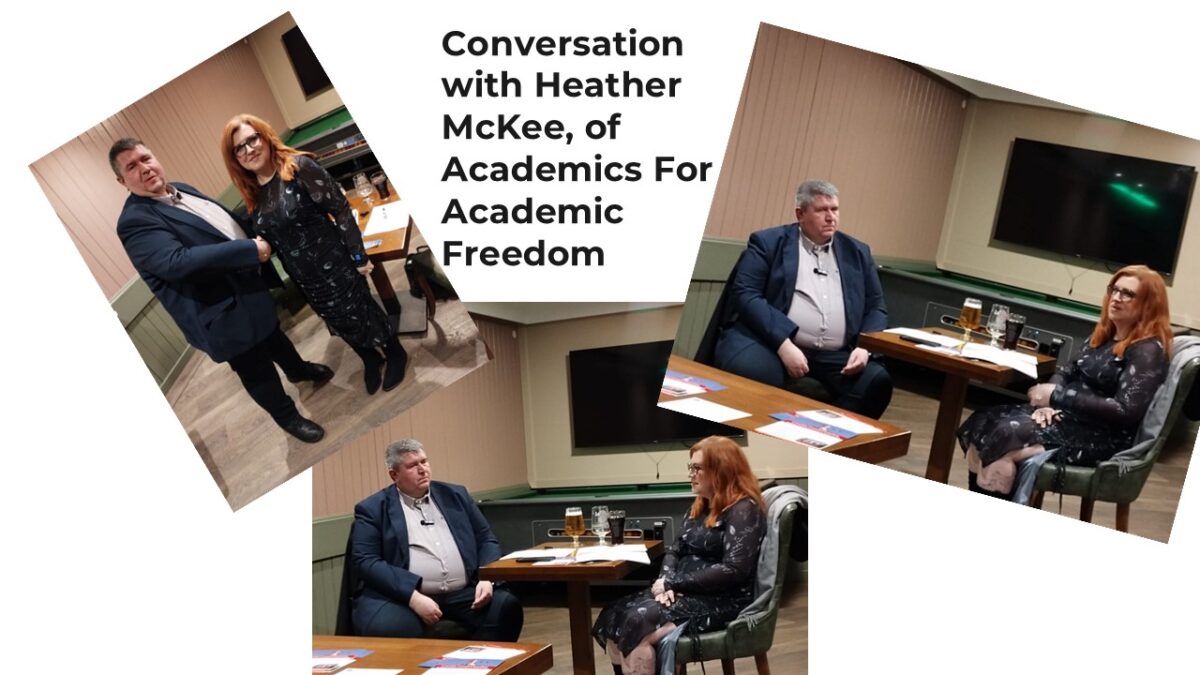
Podcast Episode 97 – Heather McKee: Academics For Academic Freedom

We recently held a public meeting in Purley and we were joined by Heather McKee, the Convenor of Students at Academics For Academic Freedom (AFAF).

You can follow Heather on X/Twitter at https://x.com/HeatherFFS and follow Student Academics For Academic Freedom at https://x.com/StudentAFAF.

Spreaker

iTunes


Podchaser

Podcast Addict
Deezer

Spotify


Castbox

Amazon