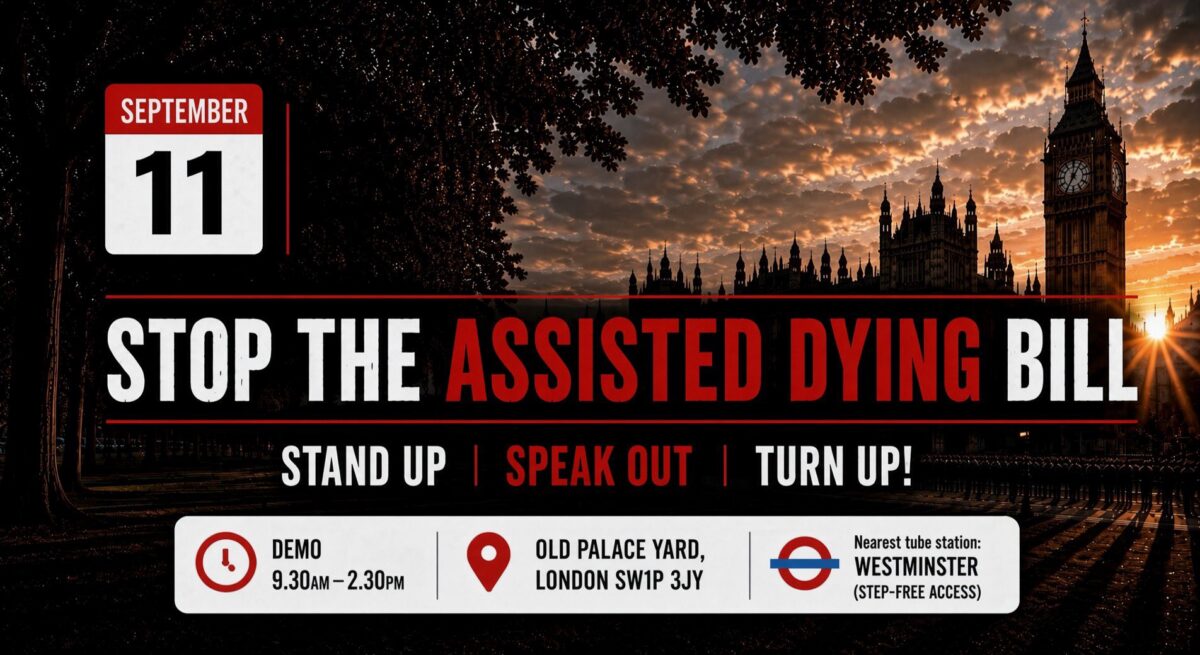
Families Against Involuntary Medical Euthanasia have let us know about a protest they have outside Parliament on September 11 against the Terminally Ill Adults (End of Life) Bill:
— Families Against Involuntary Medical Euthanasia (@EoLWatch) August 26, 2026
Stand Up. Speak Out. Turn Up! Join us outside Parliament on September 11 to protest the return of the deeply dangerous and antidemocratic #AssistedSuicideBill Let’s stop the the Kill Bill together! #NotThisBill#NotThisWay#NotNow
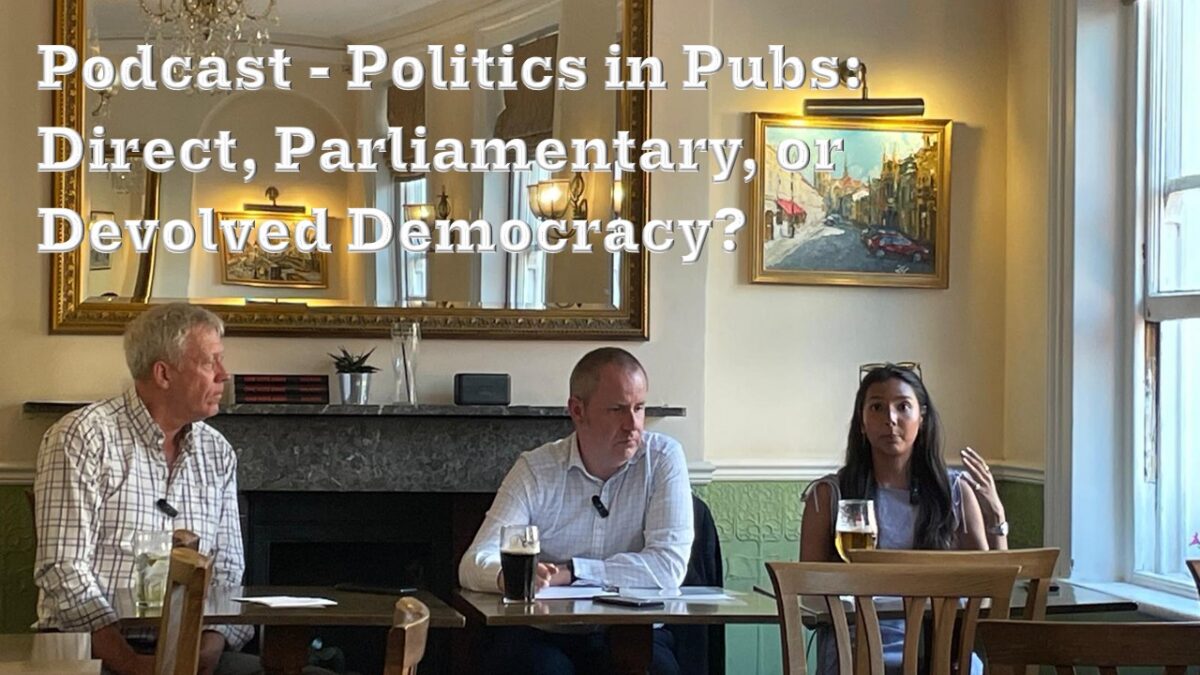
At the Politics in Pubs Central London event we were joined by Neil Petrie of The Direct Democracy Movement and Joanna Marchong, the new Senior Analyst and Head of Campaigns at Onward for a lively debate about the best form of democracy. https://politicsinpubs.org.uk/.
Onward aim to set the agenda on the right, researching and creating policies to solve the problems that are making the UK poorer, the public disillusioned, and the state less effective. They can be found at https://ukonward.com/, and on Facebook and X. Joanna Marchong can also be found on X at https://x.com/marchong_joanna.
Visit Politics in Pubs at https://politicsinpubs.org.uk/ for more on their events in London and beyond. We also have a brief write up of this event below.
The Swiss model or the drawbacks we’ve seen? – Politics in Pubs in London
Against a backdrop of frequent changes of prime minister, no party polling above ~30%, rising government debt, and talk of devolution. We had two main speakers:
Neil Petrie (Direct Democracy Movement / board member), who strongly favours a Swiss-style semi-direct democracy.
Joanna Marchong (Senior Analyst and Head of Campaigns at the Onward think tank), who is more sceptical of how devolution has worked in the UK and highlighted accountability problems.
Neil Petrie’s main points:
The UK’s pure parliamentary/representative system is fundamentally flawed and “corrupt from the outset.” He described party whips as a “handling operation” (historically called the patronage secretary) that keeps MPs in line via patronage, with leaders themselves controlled by backers. Voters rarely feel heard.
Neil advocated the Swiss model (in place since 1848): a mix of representative parliament plus citizen rights to force referendums. He summarises it as the “0-1-2 system”:
Mandatory referendums for constitutional changes.
1% of voters can trigger a referendum on new legislation.
2% can launch a popular initiative (propose new ideas themselves).
Referendums happen several times a year (national and local). Decision-making is pushed down via subsidiarity (to cantons and communities) where possible; major issues like defence stay federal.
Switzerland has far lower debt-to-GDP (<40% vs UK >100%), people control the purse strings and therefore spend more carefully than politicians, and the country uniquely has nuclear shelters for its entire population (~9 million). He references US state-level initiatives (e.g. California) and the book Let the People Rule as supporting evidence that voters are more fiscally responsible than legislators.
Brexit was a rare positive example of (limited) direct democracy. He has long supported the idea (via the Referendum Party, UKIP, etc.) and notes Nigel Farage has praised the Swiss system.
Joanna Marchong’s main points:
Joanna agrees trust in politics and turnout are at historic lows and that people want to feel heard, but argues that simply moving power closer to people (devolution or more referendums) does not automatically improve outcomes.
UK devolution evidence is poor after 25 years in Scotland and Wales:
Scottish education was among Europe’s best in 1999; maths scores are now below the England average and at OECD levels.
Crime remains high; drug deaths are far worse than the European average (roughly four times the level when Trainspotting came out).
A&E waiting times that are linked to hundreds of avoidable deaths per year.
Per-capita funding has been higher than in England, yet results have deteriorated.
True devolution requires both the power to spend and full accountability for failure (no automatic Westminster bailouts). Many current UK metro-mayor and council arrangements lack this; some (e.g. Andy Burnham in Greater Manchester) have delivered visible successes such as bus fares, while newer or less experienced ones struggle with budgets, ring-fenced spending, social care, SEND, etc. Examples of heavily indebted councils (Birmingham and others) illustrate the problem.
Referendums have drawbacks: they “unbundle” issues that should be traded off together (e.g. “more NHS spending?” gets a yes; “higher taxes?” gets a no). Simple binary questions ignore complexity and can lock governments into conflicting mandates for years (as seen in California). Parliament’s job, done properly, is to package competing public preferences into coherent budgets and policy. The current system fails at this, which is why people demand referendums, but switching wholesale risks worse outcomes.
Cultural and institutional differences mean Swiss or US models do not transplant easily to the UK. Any serious devolution needs stronger local capacity, genuine fiscal responsibility, and clearer national-local boundaries.
The discussion was lively and civil. Neil repeatedly stresses that giving citizens veto/initiative power produces more sensible, lower-debt outcomes. Joanna repeatedly stresses evidence of under-performance under existing UK devolution and the practical difficulties of pure direct democracy. We took a short break for drinks, followed by an audience Q&A.
In July, the TaxPayers’ Alliance published their now-annual NHS Rich List. Among its key findings were that in 2024-25, there were 1,603 NHS managers on a salary of £100,000 or more. This included 17 who had salaries over £300,000, and 574 senior managers who had a salary greater than the prime minister’s (£172,153).
“Taking a leaf out of our local council’s book, they were one of only three trusts for which “No accounts have been published.”
Of course, it’s not just salary that matters: 292 NHS senior managers received at least £300,000 in total remuneration (comprising salary, expenses, benefits, bonuses and pension benefits). The highest salary belonged to a senior manager at Newcastle upon Tyne Hospitals, receiving £377,500 (£382,500 total remuneration). The trust was ranked 41 out of 140 in England for A&E waiting times, a solid but unremarkable performance on this indicator. Nottingham University Hospitals (131 of 140 for A&E waiting times in England) had a chief nurse who received a total remuneration of £ 712,500. The full research paper makes fascinating reading.
Being the Croydon Constitutionalists, we would like to bring you details from our own local Croydon Health Services NHS Trust. Taking a leaf out of our local council’s book, they were one of only three trusts for which “No accounts have been published.” Helpfully, the Trust does suggest that “Further details of staff and board members’ allowances and expenses may be obtained by emailing ch-tr.foil@nhs.net.” More helpful would have been publishing their information, like 193 other trusts.
“574 senior managers who had a salary greater than the prime minister’s”
Looking at other trusts serving south London, the most striking figures include:
Epsom and St Helier University Hospitals (some of these were shared with St George’s University Hospitals NHS Trust to which 50% recharged. Figures obtained by combining accounts).
Group deputy chief executive officer, who received a salary of £265,000 + £17,500 bonus, plus £1,591,250 pension-related benefits. A total of £1,875,000.
Group Chief Nursing Officer. A salary of £185,000 plus £1,103,750 pension-related benefits for a total £1,290,000.
St George’s University Hospitals
Group Chief Executive’s salary of £335,000 (shared, 50% recharged with Epsom and St Helier University Hospitals).
South London and Maudsley
Chief Executive’s salary of £232,500 plus a £321,250 pension for a total £552,500.
King’s College Hospital (which includes Princess Royal University Hospital in Bromley)
Chief Executive’s salary of £337,500.
Chief Nurse’s salary of £197,500 plus £461,250 pension for a total of £657,500.
South West London and St George’s Mental Health
Chief Executive’s total remuneration of £337,500.
Chief Medical Officer’s total remuneration of £367,500.
These and other details are available in the Full Dataset.
“I would like to think most of what happens in the NHS is about living, but in the Midlands Partnership University they seem to have a specific ‘Director for lived experience”
National Picture
Of the 1474 jobs listed some job titles leap out of the data. Whilst the title may not comprehensibly cover the role undertaken, and no doubt many do incredibly worthwhile work, at first glance some might be categorised as ‘nice work if you can get it’.
The Royal Papworth Hospital has an ‘Advisory non-voting member’ receiving a total remuneration of £147,500. I would like to think most of what happens in the NHS is about living, but in the Midlands Partnership University they seem to have a specific ‘Director for lived experience’ on a total remuneration of £157,500.
You could argue the value of one’s lived experience is enhanced by culture. Thankfully the University Hospitals Sussex have this covered with a ‘Chief culture and organisational development officer’ receiving £167,500 per annum. As does Mersey Care with a ‘Chief people and culture officer/deputy chief executive for non-clinical services’ receiving £187,500, Walsall Healthcare, via a ‘Director of culture and people’ receiving £167,500, East Lancashire Hospitals with a ‘Executive director of people and culture’ receiving £187,500, Essex Partnership University whose ‘Executive director of people and culture’ receives £327,500, North East London where there is an ‘Executive director of people and culture’ receiving £152,500 this compares to the ‘Executive director of people and culture’ at Nottinghamshire Healthcare receiving £142,500, or the one at Blackpool Teaching Hospitals receiving £162,500. Of course only being a ‘Director of people and culture’ brings your total package in at £147,500 at James Paget University Hospitals.
“Thankfully the NHS keeps receiving the record budgets, so vital in funding HR executives across the country”
Some of these roles overlap with HR or ‘People’ as they are the role is now often referred to. At the Bradford Teaching Hospitals this role is covered by the ‘Chief people and purpose officer’ receiving £172,500 (with great purpose no doubt). Directors of people and HR variously receive £147,500 at the Portsmouth Hospitals University, £135,500 at Central London Community Healthcare, £142,500 at Sheffield Health and Social Care, and £157,500 at Great Ormond Street Hospital for Children. Thankfully the NHS keeps receiving the record budgets, so vital in funding HR executives across the country.
NHS Trusts don’t run themselves, they need a ‘Chief corporate affairs officer’ (total remuneration (£232,500) at Alder Hey Children’s Trust, or a ‘Chief of strategy and partnerships’ (£227,500) in Bolton, or a ‘Chief of strategy and transformation’ (£157,500) in Hampshire and Isle of Wight Healthcare Trust, or as the Royal Cornwall Hospitals have a ‘Chief performance, partnerships and transformation officer’ (£192,500).
You might wonder how we the public know all this (aside from the great work done by the TaxPayers’ Alliance). Well, I’m pleased to note the South West London and St George’s Mental Health Trust has that covered with a ‘Better communities programme director’ (£192,500) and the Sussex Partnership covers it with a ‘Chief communications officer’ (£162,500). Trusts like Northumbria Healthcare, Liverpool University Hospitals, University Hospitals of North Midlands, York and Scarborough Teaching Hospitals, Wrightington, Wigan and Leigh, and South West London and St George’s Mental Health, have this crucial role covered with a ‘Director of communication’, ‘Director of communications’, or a ‘Director of communications and stakeholder’ on total packages ranging from £107,500 to £232,500.
Mal McDermott of the Libertarian Party UK writes about many of the problems holding Britain back.
“Everything is always a problem, one to complain about, write to a councillor about, form a committee about”
The heat has been quite something as you may have noticed, from my side of the country in the depths of the Souf,to the frozen lands beyond the wall (Speculation states that Scots are having a Y2K moment as their thermometers don’t go into double digits) we are having a hot time of it.
On top of this we have had the usual slew of hosepipe bans, wilting crops, people getting into trouble in the water trying to cool off, cracked pavements, non-air-conditioned homes presumably built in the last ice age for heat retention and the useful small talk of “how about this heat?”
“Where is the entrepreneurship? Where are the people selling ice cream and beer on the beach, the swim teams forming volunteer life guard groups”
Problem after moan after problem after whinge. It’s a typical response, but also a result of policy and culture. Everything is always a problem, one to complain about, write to a councillor about, form a committee about, get an MP in for a photo op about. Because God forbid that anyone with no doubt scurrilous, exploitative and capitalistic tendencies would actually do something about.
Where is the entrepreneurship? Where are the people selling ice cream and beer on the beach, the swim teams forming volunteer life guard groups, the people hawking cheap sunglasses bought in bulk of Temu? There at home, complaining on the internet, begging a faceless bureaucracy to fix their lives.
But they’re not entirely to blame, their whole lives they’ve been fed this line, they have witnessed every attempt at private industry being crushed by red tape and taxes. Why bother trying to do anything when Johnny Law is just going to kick down your door and send you to the slammer longer than someone convicted of manslaughter for trying to hawk a can of Carlsberg on the Sea shore?
“Vape and betting shops are to be stamped out by the politburo. Zero fun allowed, now get back to work or being depressed”
Andy Burnham, himself from beyond the Watford gap and his collection of conniving communists are this week attempting to crack down at the last response to this constant crack down. Vape and betting shops are to be stamped out by the politburo. Zero fun allowed, now get back to work or being depressed in bed, either suits the Labour louts. The fact that taxes and rates have meant that only insanely high margin businesses can operate would of course be sacrosanct to the Marxist ghouls in charge.
“we are beaten down by a state of busy body pencil pushers who are clueless of the realities outside of their projected models”
We are supposed to be a capitalist society, problems are to be met with ingenuity, solutions and profit. Everyone benefits, people beat the heat and others bring home the bacon. Instead, we are beaten down by a state of busy body pencil pushers who are clueless of the realities outside of their projected models and let’s be honest what they reckon is going on.
Is there a percentage something could go wrong, possibly, but whatever it is, it won’t be 100%, so we are always getting less than we could as a government ban means everyone gets 0%. The UK should be enjoying a pop-up and small business boom. Instead thousands more will be jobless and I’m left beerless on the beach, watching the waves, and in the distance, is that a small boat I see?…
“God forbid that anyone with no doubt scurrilous, exploitative and capitalistic tendencies would actually do something”