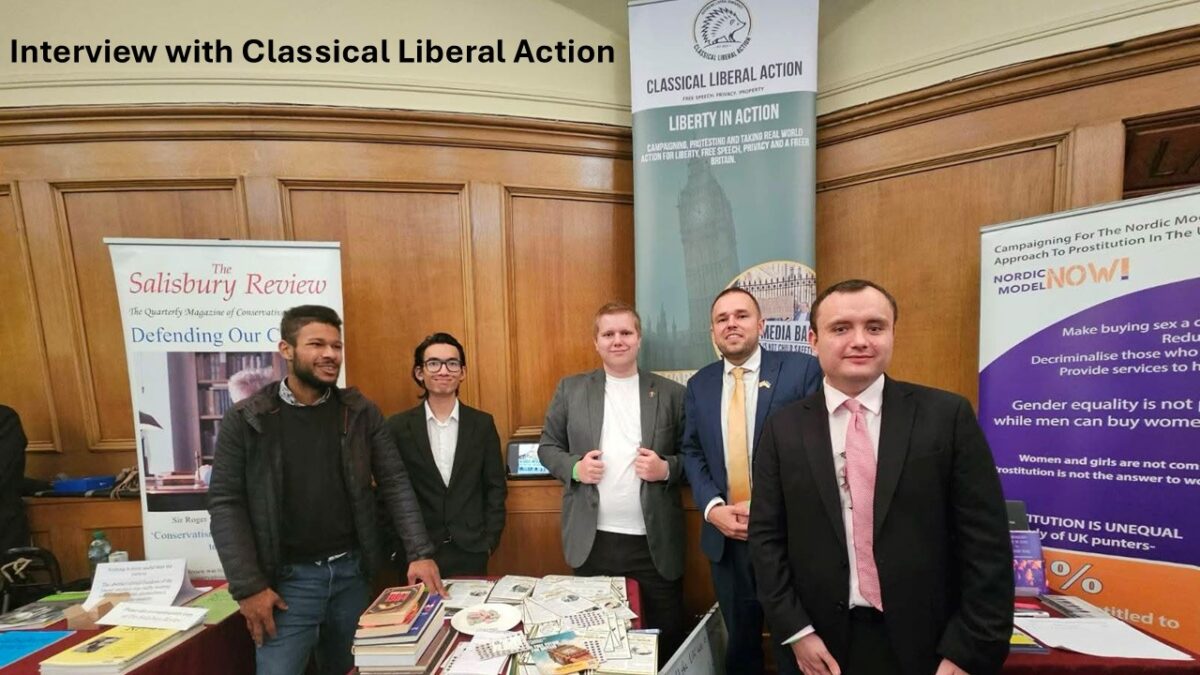
With core values of independence, civil liberties, accountability and open debate, Classical Liberal Action is a new organisation formed by former UK Libertarian Party members alongside other classical liberals and liberty-minded individuals.
We speak to a representative of Classical Liberal Action about the group’s origins, values and ambitions.
“there wasn’t really a group doing much on-the-ground activism or bringing people together to promote liberty, so we wanted to change that”
Can you introduce yourself and let us know what inspired the creation of Classical Liberal Action?
We founded Classical Liberal Action to give libertarians, classical liberals and other liberty-minded people an organisation and community to come together around.
We noticed that in the current political climate, there wasn’t really a group doing much on-the-ground activism or bringing people together to promote liberty, so we wanted to change that.
There are plenty of great think tanks promoting libertarian and classical liberal ideas, but what we feel is missing is a real street presence and a community around them that allows individuals to come together and take political action.
“allowing people to make their own choices, express their views, associate with others and take responsibility for their own lives”
Can you expand on your core values and what they mean in practice?
We believe that the main purpose of government should be to protect our natural and human rights and allow individuals to grow and develop.
For us, liberty is about more than just having a smaller government. It’s about allowing people to make their own choices, express their views, associate with others and take responsibility for their own lives.
We also believe in accountability, open debate and protecting individual rights, even when those rights are unpopular or politically inconvenient.
We welcome both orthodox and unorthodox libertarians, as well as classical liberals and other liberty-minded individuals. We don’t expect everyone to agree on everything, and we believe that having different views and being able to openly debate them is an important part of any healthy political movement.
“The danger is that we slowly normalise surveillance. Every new measure makes the next one easier to introduce”
Privacy and surveillance are recurring themes in your work. What do you see as the biggest threat to personal privacy in Britain today?
We obviously see things such as the Online Safety Act, facial recognition and Digital ID as major concerns when it comes to privacy and individual freedom.
But we believe the greater threat is the growing public acceptance of these measures, often in response to current events, and a general lack of concern about privacy beyond the occasional news story that screams 1984.
We are also seeing people on both the left and the right calling for greater government powers to be used against their political opponents, often without considering how those same powers could be used against them in the future.
The danger is that we slowly normalise surveillance. Every new measure makes the next one easier to introduce, and before long things that would have been considered unacceptable a few years ago become part of everyday life.
Privacy and individual rights should be principles that we defend consistently, not just when it suits our own political views.
“One of our longer-term aims is to help develop a more British form of libertarianism, one that draws on our own history of civil liberties, common law, individual rights and political traditions”
Many of your articles criticise government intervention and regulation. What role do you believe the government should play in people’s everyday lives?
We believe that the main role of government should be to protect people’s rights and freedoms, uphold the rule of law and allow individuals to live their lives without unnecessary interference.
We don’t believe that government should be involved in every aspect of people’s lives or that every problem requires a new law or regulation.
We have quite a mixed membership, ranging from orthodox libertarians to more unorthodox libertarians and classical liberals. While we might disagree on the exact role and size of government, we generally agree that individuals should have greater freedom and control over their own lives.
One of our longer-term aims is to help develop a more British form of libertarianism, one that draws on our own history of civil liberties, common law, individual rights and political traditions rather than simply importing ideas from the United States.
After all, Britain played a major part in the Enlightenment and produced thinkers such as John Locke and Adam Smith. Locke helped develop the idea of natural rights, arguing that individuals have rights to life, liberty and property, and that government gets its authority from the consent of the governed. Adam Smith, meanwhile, helped lay the foundations of modern economics and classical liberal thought, arguing for free trade, competition and the benefits of individuals being free to pursue their own economic interests.
We also have thinkers such as John Stuart Mill, who defended individual liberty and freedom of expression, as well as a rich history of political movements, from the Chartists fighting for democratic reform to the Anti-Corn Law League campaigning for free trade.
We can also look at our history of voluntary cooperation, from the Anti-Mill in Beverley and the Rochdale Pioneers, who came together to establish cooperative businesses, to the Tolpuddle Martyrs, who stood up for the right of workers to organise and associate freely.
These examples come from different political traditions, including those associated with both the left and right. They show that ideas such as free markets, individual rights, voluntary cooperation and freedom of association have deep roots in British history.
The UK has its own issues, cultural norms and political traditions that are different from those in America and the rest of the world. We believe libertarianism in Britain needs to recognise these differences and develop ideas that are relevant to British society rather than simply copying what works elsewhere.
Ultimately, we believe government should exist to serve individuals, not the other way around.
“property rights and the freedom to trade and cooperate voluntarily are just as important as our personal freedoms. Economic freedom and personal liberty should go hand in hand”
What are the top three policy changes you would most like to see to strengthen civil liberties in the UK?
There are quite a few things we would like to see changed, but if we had to narrow it down, four areas stand out to us.
First, privacy. We would like to see the Online Safety Act repealed and greater restrictions placed on the use of mass surveillance, particularly live facial recognition. We believe people should have the right to go about their everyday lives without being constantly monitored.
Second, freedom of speech and expression. We believe people should be free to express their opinions, including unpopular or controversial ones, without unnecessary government interference. We are particularly concerned about the growing use of laws and regulations to police what people can say online.
Third, protecting our legal rights. We believe that trial by jury, due process and the presumption of innocence are essential safeguards against the misuse of government power. These rights should be strengthened rather than weakened.
Fourth, economic freedom. We believe individuals should have greater control over their own money, property and economic decisions. We would like to see a simpler tax system, lower taxes and fewer unnecessary regulations that make it harder for people to start businesses, find work or build wealth.
We also believe that property rights and the freedom to trade and cooperate voluntarily are just as important as our personal freedoms. Economic freedom and personal liberty should go hand in hand.
Ultimately, we believe civil liberties should apply to everyone, regardless of their political views or whether we personally agree with them.
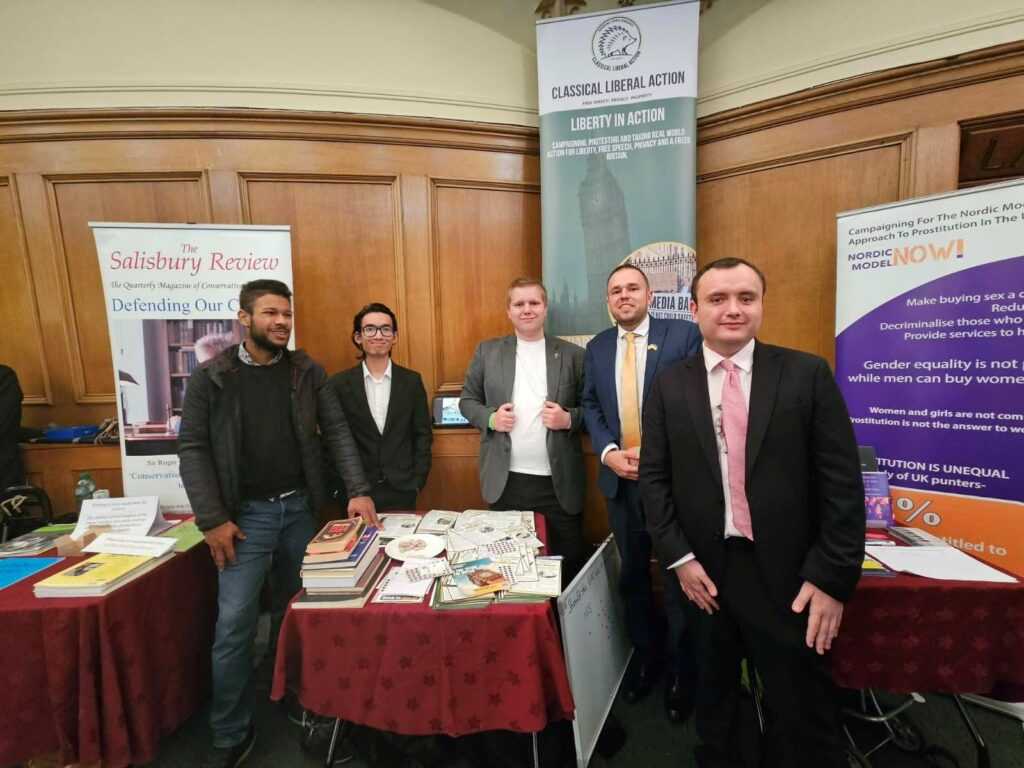
You can find out more and follow Classical Liberal Action online at https://liberalaction.org.uk/ and on:
Instagram: https://www.instagram.com/classicalliberalaction
Facebook: https://www.facebook.com/profile.php?id=61591509377668
X / Twitter: https://x.com/CLActionUK