
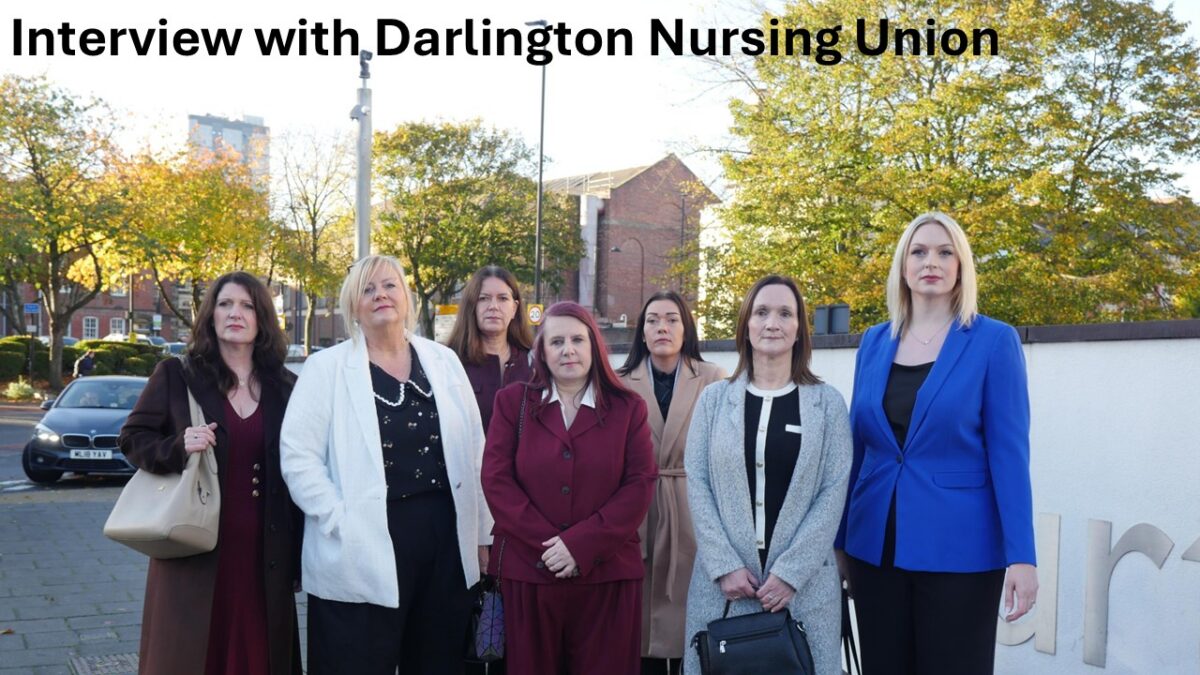
The Darlington Nursing Union exists to defend women’s rights and safe spaces in the workplace. We interview their President Bethany Hutchison, about the unions work.
“We raised concerns which were repeatedly dismissed and ignored. HR told us we needed to ‘get educated’, ‘be more inclusive’”
Can you introduce yourself to our readers and tell us about the Darlington Nursing Union and why it exists?
I’m Bethany Hutchison, a frontline nurse and President of the Darlington Nursing Union. This issue found us in an NHS staff changing room after female nurses at Darlington Memorial Hospital discovered, without a warning or consultation, that men who identify as women were allowed under and NHS policy to use the female staff changing room.
We raised concerns which were repeatedly dismissed and ignored. HR told us we needed to ‘get educated’, ‘be more inclusive’, ‘compromise’ and ‘broaden our mindset.’ For raising concerns we were forced to change in a converted office for 10 months that opened on to a public corridor and clinical area. We were also reported to the Nursing and Midwifery Council for speaking publicly about our experiences.
We turned to Unison and Royal College of Nursing, but neither would support. When we met with then health secretary, Wes Streeting, during our case, the President of Unison, Steve North accused him of ‘pandering to anti-trans bigotry’.
“Our purpose is to defend the dignity, safety and employment rights of healthcare staff”
With the support of lawyers at the Christian Legal Centre, we launched the Darlington Nursing Union, a first of its kind union dedicated to biological reality and women’s dignity.
We exist to give nurses a voice when established institutions fail to listen. Our purpose is to defend the dignity, safety and employment rights of healthcare staff, particularly women who may otherwise feel unable to raise concerns. We also want to encourage a culture in which nurses can speak honestly about safeguarding and workplace practice without fearing disciplinary action or damage to their careers.
In January 2026, following a three-week employment tribunal, we succeeded in our claims against County Durham and Darlington NHS Foundation Trust, who were found to have unlawfully harassed and discriminated against us. The ruling said the Trust had violated our dignity and created a hostile, humiliating and degrading environment.
“employers are beginning to understand that privacy and dignity cannot simply be set aside in the name of inclusion”
How do you feel the battle to defend access to single-sex spaces is going? What is working and what are the open challenges?
There has undoubtedly been progress. The judgment of the Supreme Court in For Women Scotland Ltd v The Scottish Ministers brought much-needed legal clarity. It confirmed that the words “man”, “woman” and “sex” in the Equality Act 2010 refer to biological sex.
What is working is that more women are willing to speak openly, more cases are being tested against the law, and employers are beginning to understand that privacy and dignity cannot simply be set aside in the name of inclusion. Our own experience shows that determined, lawful action can produce change.
We have now also helped secure guidance from NHS England that recognises biological reality when applied to staff and patient facilities in the NHS.
However, significant challenges remain. Some organisations still have policies based on an incorrect understanding of the law, while others may change their written policies without changing the workplace culture that caused the problem. Staff can also remain frightened of being labelled prejudiced or reported to their professional regulator for raising legitimate concerns.
The next stage is therefore about implementation. It is not enough for the law to be clear on paper. NHS trusts, regulators and unions must ensure that staff have genuinely private, dignified and safe facilities in practice. This should be done fairly and respectfully, without subjecting anyone to harassment or humiliation.
“the organisations they trusted to represent them were more interested in defending an institutional position than listening to their experience”
You’ve been critical of how some larger unions handled concerns about single-sex spaces. What hope do you have that some of the main unions will change their views?
I hope they will change, because trade unions should exist to defend their members, particularly when members raise concerns about safety, dignity or unlawful workplace treatment.
Our experience has exposed a serious gap between what some unions say about representing women and what can happen when women question policies concerning sex and gender. Too often, legitimate concerns have been treated as an ideological problem rather than an employment-rights issue. Some nurses have felt that the organisations they trusted to represent them were more interested in defending an institutional position than listening to their experiences.
Nevertheless, unions can change. The legal position is now clearer, and there is growing public awareness of what women in workplaces such as ours have faced. Union leaders have an opportunity to review their policies, listen to members with different perspectives and return to first principles: protecting workers, supporting lawful practice and allowing respectful disagreement.
The test will be practical. Will unions support a female nurse who asks for a changing room in which she will not encounter a member of the opposite sex? Will they defend staff who raise safeguarding concerns in good faith? Will they represent all members rather than only those whose views fit an approved position? If they can answer those questions positively, trust can begin to be rebuilt.
“compassion does not require us to deny material reality, and respectful treatment of trans-identifying colleagues does not require women to surrender their own rights”
With the Trust’s policy now aligned with the Supreme Court’s ruling on biological sex and with growing public and political attention on the issue, what are your main priorities for the next year or two?
Our first priority is to make sure the policy change is implemented consistently and that women across the Trust genuinely have access to private, single-sex changing facilities. A policy is only meaningful if staff understand it, managers apply it and nurses can rely on it without having to fight an individual battle.
Second, we want to help nurses elsewhere. Women in other hospitals and healthcare settings may be facing similar situations but feel isolated or frightened about speaking out. We want them to know that they are not alone and that asking for privacy, dignity and safety is reasonable.
Third, we want employers, established unions and professional regulators to learn from what happened in Darlington. No nurse should face threats to her job or professional standing simply because she raises a lawful concern about intimate facilities or safeguarding. Employers should address these matters early, respectfully and in accordance with the Equality Act, rather than allowing disputes to escalate for years.
Finally, we want to contribute to a better culture within nursing: one in which compassion does not require us to deny material reality, and respectful treatment of trans-identifying colleagues does not require women to surrender their own rights. Healthcare professionals routinely balance different needs and protected characteristics. With clear policies and mutual respect, that balance is achievable.
“Our own experience shows that determined, lawful action can produce change”
How can people get in touch and find out more?
People can follow the Darlington Nursing Union on X, @DarlingtonUnion on Facebook and by emailing info@darlingtonnursingunion.uk , where we publish updates about our work, our case and wider developments affecting nurses’ rights.
We particularly want to hear from healthcare workers who are experiencing similar difficulties, as well as from people who would like to support our work. Even if someone is not yet ready to speak publicly, knowing that others understand what they are facing can be extremely important.