Mal McDermott of the Libertarian Party UK writes about many of the problems holding Britain back.
“Everything is always a problem, one to complain about, write to a councillor about, form a committee about”
The heat has been quite something as you may have noticed, from my side of the country in the depths of the Souf,to the frozen lands beyond the wall (Speculation states that Scots are having a Y2K moment as their thermometers don’t go into double digits) we are having a hot time of it.
On top of this we have had the usual slew of hosepipe bans, wilting crops, people getting into trouble in the water trying to cool off, cracked pavements, non-air-conditioned homes presumably built in the last ice age for heat retention and the useful small talk of “how about this heat?”
“Where is the entrepreneurship? Where are the people selling ice cream and beer on the beach, the swim teams forming volunteer life guard groups”
Problem after moan after problem after whinge. It’s a typical response, but also a result of policy and culture. Everything is always a problem, one to complain about, write to a councillor about, form a committee about, get an MP in for a photo op about. Because God forbid that anyone with no doubt scurrilous, exploitative and capitalistic tendencies would actually do something about.
Where is the entrepreneurship? Where are the people selling ice cream and beer on the beach, the swim teams forming volunteer life guard groups, the people hawking cheap sunglasses bought in bulk of Temu? There at home, complaining on the internet, begging a faceless bureaucracy to fix their lives.
But they’re not entirely to blame, their whole lives they’ve been fed this line, they have witnessed every attempt at private industry being crushed by red tape and taxes. Why bother trying to do anything when Johnny Law is just going to kick down your door and send you to the slammer longer than someone convicted of manslaughter for trying to hawk a can of Carlsberg on the Sea shore?
“Vape and betting shops are to be stamped out by the politburo. Zero fun allowed, now get back to work or being depressed”
Andy Burnham, himself from beyond the Watford gap and his collection of conniving communists are this week attempting to crack down at the last response to this constant crack down. Vape and betting shops are to be stamped out by the politburo. Zero fun allowed, now get back to work or being depressed in bed, either suits the Labour louts. The fact that taxes and rates have meant that only insanely high margin businesses can operate would of course be sacrosanct to the Marxist ghouls in charge.
“we are beaten down by a state of busy body pencil pushers who are clueless of the realities outside of their projected models”
We are supposed to be a capitalist society, problems are to be met with ingenuity, solutions and profit. Everyone benefits, people beat the heat and others bring home the bacon. Instead, we are beaten down by a state of busy body pencil pushers who are clueless of the realities outside of their projected models and let’s be honest what they reckon is going on.
Is there a percentage something could go wrong, possibly, but whatever it is, it won’t be 100%, so we are always getting less than we could as a government ban means everyone gets 0%. The UK should be enjoying a pop-up and small business boom. Instead thousands more will be jobless and I’m left beerless on the beach, watching the waves, and in the distance, is that a small boat I see?…
“God forbid that anyone with no doubt scurrilous, exploitative and capitalistic tendencies would actually do something”
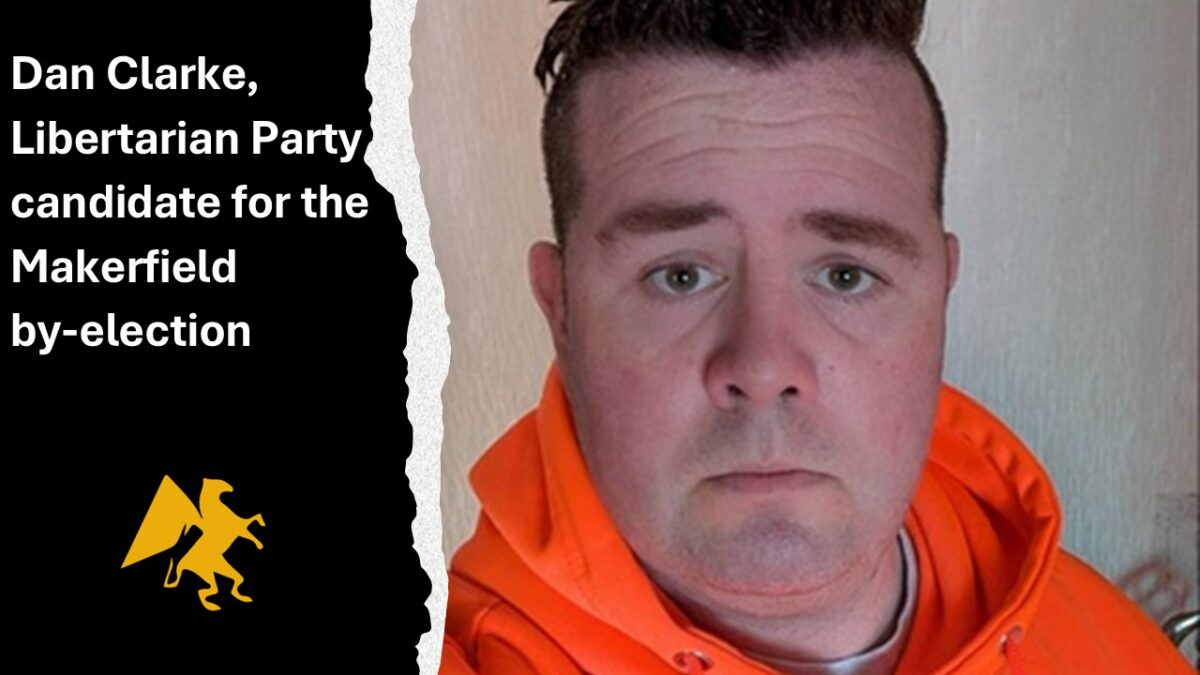
With the Makerfield by-election hitting the headlines we speak with Dan Clarke, the Libertarian Party candidate.
Can you briefly introduce yourself to our readers?
I’m Dan Clarke, I’m the Libertarian Party Parliamentary candidate for the Makerfield by-election. Which is taking place on 18th June. I am also standing in a local council by election for Farnworth ward (Widnes) which is taking place on 25th June.
“We are completely against the “Digital ID” that this authoritarian government is obsessed in pushing through”
Can you outline the main policies and principles of the Libertarian Party?
Our main principles are lower taxes, maximum personal freedom and implementation of a Constitution for the United Kingdom. We want to Enshrine the right to digital freedoms into constitutional law. We are completely against the “Digital ID” that this authoritarian government is obsessed in pushing through.
“This is definitely a by-election to get rid of Starmer, regardless of who wins”
What do you see as the big issues for Makerfield and what if elected what would you hope to champion?
The big issues I see in Makerfield are huge dislike of Kier Starmer. This is definitely a by-election to get rid of Starmer, regardless of who wins. If I win, I will champion constituents right to privacy. I will work tirelessly to stoop ‘Digital ID’ From happening. People have a right to privacy.
“the time for classical liberalism/Libertarianism is now. The movement is growing, we are fighting more elections”
Any other thoughts you would like to share with our readers?
My thoughts for your readers are- the time for classical liberalism/Libertarianism is now. The movement is growing, we are fighting more elections. We are showing the UK that we are here, we are serious and we will eventually succeed.
For those eager to help, how can they get involved in the campaign?
For anyone wishing to help out campaigning in Makerfield can either contact the party via our website or contact me directly via email: Dan.clarke@libertarianpartyuk.com.
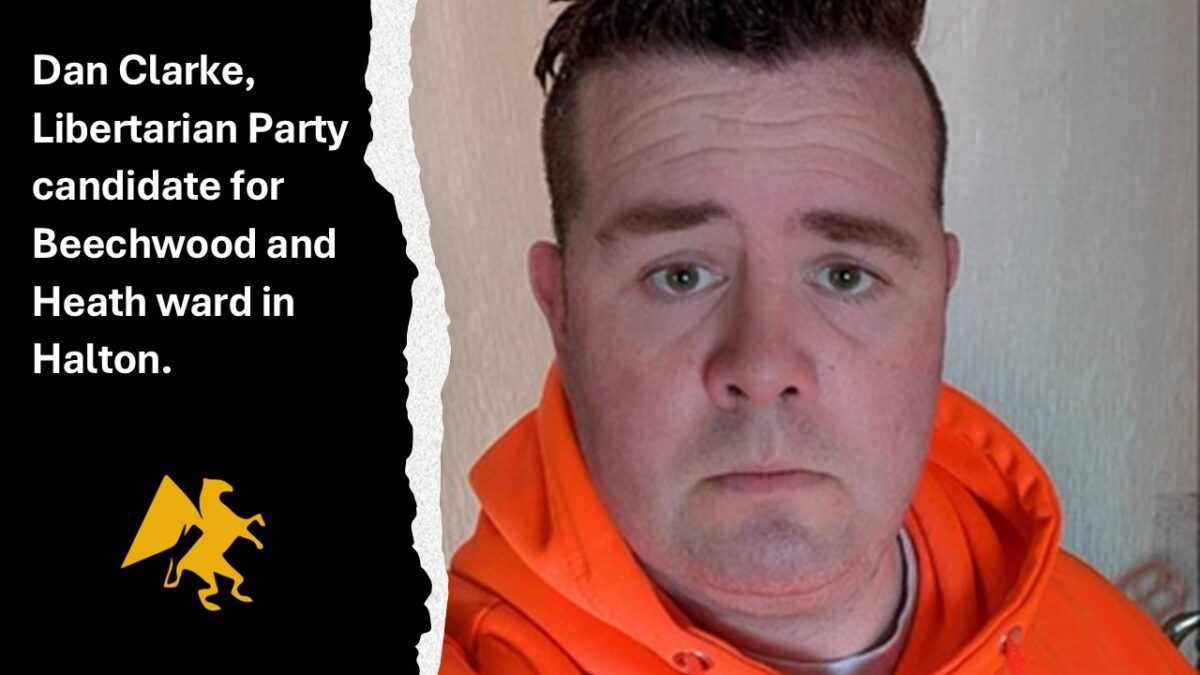
With local elections across the country in May, we speak with Dan Clarke, Libertarian Party candidate for Beechwood and Heath ward in Halton.
“I am running in the local elections because someone needs to get to grips to the council finances”
Can you introduce yourself to our readers, and tell us what made you decide to run?
I’m Dan Clarke, I have lived in Runcorn for 25 years. I am the Librarian party Coordinator for the North. I am running in the local elections because someone needs to get to grips to the council finances, and put power back into people’s hands.
“Labour and Liberal Democrat councillors have failed to listed to constituents, I plan to listen and implement the will of the people I hope to represent”
What are the main concerns in your ward and if elected what wider issues do you hope to champion?
There are several issues on Beechwood and Heath ward. The two main issues are: – 540+ houses to be built on toxic land and within close proximity to a Ineos power plant and close to UKs largest waste incinerator. Not one constituent wants it to happen. Also a boat lake on Heath park has dried up, Halton Borough Council has failed to maintain it.
I hope to get the Boat lake up and running again and work with those necessary over the property development. Labour and Liberal Democrat councillors have failed to listed to constituents, I plan to listen and implement the will of the people I hope to represent.
How can people find out more or get involved in the campaign?
“540+ houses to be built on toxic land and within close proximity to a Ineos power plant and close to UKs largest waste incinerator. Not one constituent wants it to happen”
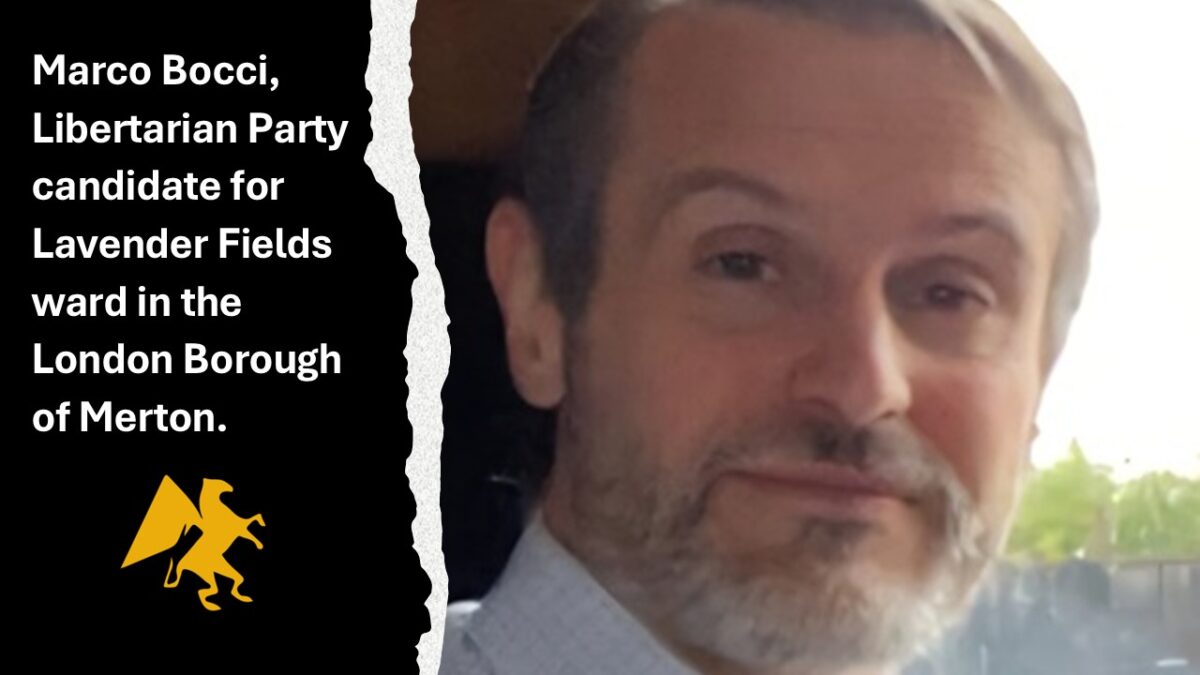
With local elections across London in May, we speak with Marco Bocci, Libertarian Party candidate for Lavender Fields ward in the London Borough of Merton.
“I decided to stand because I believe I can make a difference, bring back values that seem to be lost in the political world”
Can you introduce yourself to our readers, and tell us what made you decide to run?
My name is Marco Bocci and I decided to get involved in politics after being let down over and over by politicians who always promise a lot and deliver very little. The easiest thing to do for us citizens is to just forget about it and get on with our lives but, that’s just not me. I decided to stand because I believe I can make a difference, bring back values that seem to be lost in the political world today. Honesty, taking responsibility when things go wrong and delivering what promised during election times.
“providing the correct incentives for people to dispose items correctly, especially bulky ones. The council is currently going about this problem the wrong way”
What are the main concerns in your ward and if elected what wider issues do you hope to champion?
I am a candidate for councillor of the Lavender Fields ward in London Borough of Merton. One of the main issues affecting the area are the high streets that are dying due to over regulation and over taxation, my plan is to scrap business rates entirely to transform Merton in a local business and start-up hub. Other issues that I believe needs addressing are anti-social behaviour and fly tipping, the first to be tackled by reducing dark spots and the latter by providing the correct incentives for people to dispose items correctly, especially bulky ones. The council is currently going about this problem the wrong way, pop up tips are helping but not doing enough to resolve the issue.
How can people find out more or get involved in the campaign?
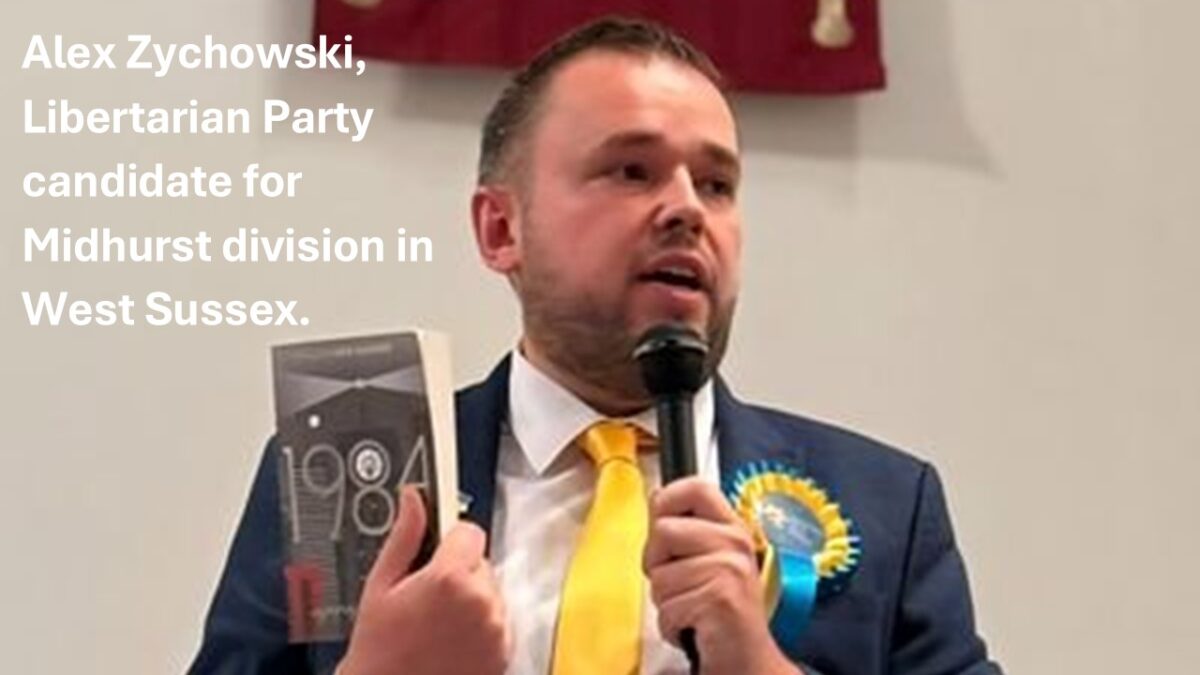
With local elections across the country in May, we speak with Alex Zychowski, Libertarian Party candidate for Midhurst division in West Sussex.
“cut council tax, returning more of residents’ hard-earned cash to their pockets”
Can you introduce yourself to our readers, and tell us what made you decide to run?
I’m Alex Zychowski, a secondary school geography teacher and leader of the Libertarian Party. I am standing for two reasons: to cut council tax, returning more of residents’ hard-earned cash to their pockets, and also to protect the night skies over West Sussex.
“Cutting tax is the most essential service local government can provide during a cost of living crisis”
What are the main concerns in your ward and if elected what wider issues do you hope to champion?
Council spending in West Sussex is out of control. There is no such thing as “public” money – only taxpayers’ money. Cutting tax is the most essential service local government can provide during a cost of living crisis. I have identified savings to fund a 3% council tax reduction. This will require deep, sometimes unpopular cuts – but I am prepared to make those choices. All other candidates in this election are promising to protect or expand services. I am not. I can only promise the residents of Midhurst division some of their hard-earned money back.
As an amateur astronomer, I appreciate the value of pristine, unpolluted skies. Unfortunately, the South Downs Dark Skies Reserve appears to exist only on paper – as increasing levels of light pollution wash out our view of the Milky Way and disturb nocturnal fauna.
In March this year West Sussex County Council announced a £24 million spend on new street lighting using 4000K “cool white” bulbs – much brighter and bluer than recommended for dark sky areas and operating at wavelengths known to increase skyglow. A council that is home to a Dark Sky Reserve should not be spending millions of taxpayers’ money actively undermining it.
As a councillor, I will press the council to turn off unnecessary illumination in areas of low footfall entirely, reduce operating hours elsewhere and replace bulbs with low-intensity warm-colour LEDs at ≤3000K. This approach will lead to lower carbon emissions, save residents money and protect the view of the cosmos.
“This approach will lead to lower carbon emissions, save residents money and protect the view of the cosmos”
How can people find out more or get involved in the campaign?
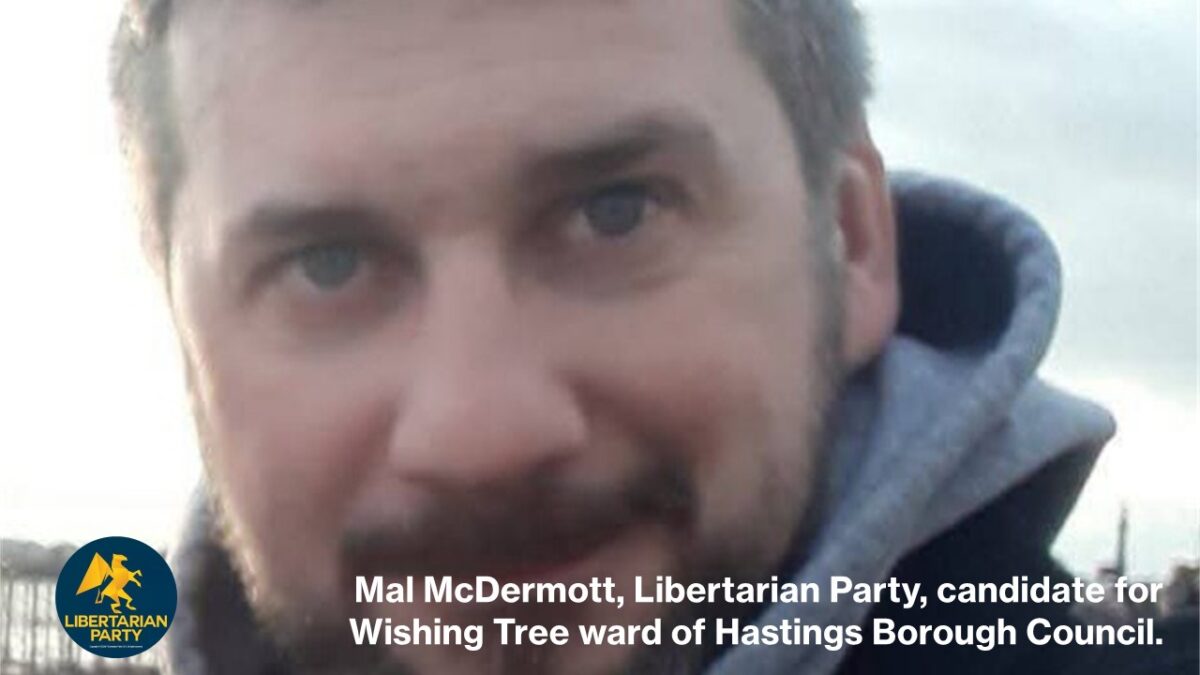
With local elections across much of the country in May, we speak with long term friend of the Croydon Constitutionalists, Mal McDermott of the Libertarian Party. Mal is running as a candidate for the Wishing Tree ward of Hastings Borough Council.
“I have decided to run as there is a need for some kind of fiscal oversight in local government”
Can you introduce yourself to our readers, and tell us what made you decide to run?
I’m Malachy McDermott, a financial analyst and former treasurer and London Group Leader of LPUK. I have decided to run as there is a need for some kind of fiscal oversight in local government and a need to deliver on meaningful projects and cut out the fluff.
What are the main concerns in your ward and if elected what wider issues do you hope to champion?
I’m running in St Leonards-on-Sea in the Wishing Tree ward. I’d like to see an improvement to our roads which have been wildly neglected as of late. On top of that I would like to act as a people’s fiscal watchdog, keeping them informed of how their money is being spent. Transparency and Fiscal Responsibility are the key components of my campaign. Although the current finances look okay, under the hood there is a lot more that needs to be done to make the area financially secure.
“I’d like to see an improvement to our roads which have been wildly neglected as of late”
How can people find out more or get involved in the campaign?
Alex Zychowski leader of the Libertarian Party UK writes a New Years message for Libertarians.
“This general malaise is symptomatic of the decline of the UK – years old, and now accelerated under Starmer.”
Returning to the UK from a winter-sun holiday on New Year’s Eve was a nasty shock to the system. The transition from 22°C and sunshine to a below-freezing Gatwick Airport was bad enough; having to wait 40 minutes on the tarmac because the electric stairs for disembarkation had failed “due to the cold weather” simply added to it. We were left with an extended opportunity to mull our impending return to work and taxation – to finance Labour’s bloated welfare state and the lives of the workshy and economically illiterate.
While browsing the web in the queue for passport control two news stories stood out. First, that 2025 was a record year for Channel crossings: 41,000+ people welcomed into the UK illegally and ferried to NHS appointments by taxi at taxpayers’ expense. Second, that Labour want to extend Digital ID to children at birth. Reading this news as a law-abiding taxpayer while waiting for an Orwellian facial-recognition scan as a condition of entry to the very country whose (selectively deployed) surveillance infrastructure we are forced to fund, it was little wonder smiles were hard to come by on the faces of fellow festive-season travellers. This general malaise is symptomatic of the decline of the UK – years old, and now accelerated under Starmer.
“astronomical energy costs that are now amongst the highest in the world – courtesy of net-zero zealotry – while punters in Beijing and Baltimore sit toasty and warm.”
New Year’s Day was lunch with the extended family in a country pub. The venue was cold, the twelve of us huddled together, eating with our coats on. Uncle Mark’s sausages arrived undercooked and were promptly sent back to the kitchen; part of me felt sorry about the additional energy cost now incurred for the proper preparation of a portion of bangers and mash. A quick browse of Wetherspoon News reminds one that the hospitality sector effectively subsidises energy-intensive industries through the Energy and Trade Intensive Industries scheme, as government would rather prop up unprofitable industries at others’ expense than tackle the inflation-driving, astronomical energy costs that are now amongst the highest in the world – courtesy of net-zero zealotry – while punters in Beijing and Baltimore sit toasty and warm.
May 2026 was supposed to be an opportunity for the electorate to deal another blow to Starmer with the local elections. A whole raft of these are now slated to be cancelled, despite the protestations of the usually compliant Electoral Commission. Barely a peep on this assault on our democracy from the Bolshevik Broadcasting Corporation, which since Covid has become nothing more than a taxpayer-funded mouthpiece for state-approved narratives.
The year ahead may look bleak, then – but the LPUK are here and as active as ever, driving forward with our message of change and hope.
Join as a member for just £27.50 a year, and enjoy the privilege of proposing and voting on policy from the comfort of your own home as we update our manifesto in online sessions.
“A whole raft of these are now slated to be cancelled, despite the protestations of the usually compliant Electoral Commission. Barely a peep on this assault on our democracy from the Bolshevik Broadcasting Corporation”
Stand for us where local elections are still taking place; star on our new podcast Give Freedom a Chance; or help produce content for our social-media channels.
Join us in Manchester on 7th February and in London on 25th April as we protest the cancellation of elections and the imposition of a Digital ID.
Authoritarianism flourishes only where the people quietly tolerate the erosion of their freedoms. We must be the change we wish to see in the world.
Alex Zychowski
“Stand for us where local elections are still taking place”
Ben Allsop the Wessex Coordinator of the Libertarian Party UK writes some of his New Years Resolutions.
“the government will find any excuse to tax and spend, regardless of the efficacy of such policies. I intend to close those gaps as much as I can by giving to worthy causes, donating blood and hopefully finding the time to volunteer”
A year ago, I set out five new year’s resolutions for the British public in 2025:
Stop Tolerating Dishonesty
Treat Taxation as Theft
Practice Individual Responsibility
Live and Let Live
Vote Libertarian
How do you think we did? How did you do? Is there anything you would like to see added to this list for the new year?
I have two of my own personal resolutions which I hope I can share.
Firstly, I would like to do more for charitable causes. As I said in my previous post, the government will find any excuse to tax and spend, regardless of the efficacy of such policies. I intend to close those gaps as much as I can by giving to worthy causes, donating blood and hopefully finding the time to volunteer once again.
Secondly, I will try to be more positive in my political activism. It is easy to adopt a cynical, sneering attitude when it comes to political commentary. There is much to be cynical about and to sneer at after all. But I am ultimately a libertarian because I have faith in the goodness of (most) human beings. A few comments over the past year have quite rightly pointed out that where criticism is given, so should solutions. So, I will endeavour to show that safety and prosperity arise because of freedom, not in spite of it. That’s not to say that I will be kind to aspiring tyrants. But I hope I can do more to convince others that there is another, brighter path forwards.
“as Joseph de Maistre said, “Every country has the government it deserves”. It is on the British public to be better then perhaps. Change is always bottom up, not top down”
Happy new year fellow libertarians! As we now find ourselves in the ‘Monday’ of months, it’s important to keep our spirits up. Granted, it’s difficult to do given the current political and economic climate. Starmer’s new year’s message was particularly nauseating. When I heard, “until you can look forward and believe in the promise and the prosperity of Britain again, then this government will fight for you,” I couldn’t help but think of “the beatings will continue until morale improves”. Needless to say, the Labour government has proven to be an utter failure in just six months. But, as Joseph de Maistre said, “Every country has the government it deserves”. It is on the British public to be better then perhaps. Change is always bottom up, not top down. So let us take this opportunity to set out five political new year’s resolutions for Britain and her electorate.
Stop Tolerating Dishonesty
We’ve had our fair share of dishonest prime ministers. The covid era and Johnson’s infamous cake ambush come sharply to mind. But few Prime Ministers have been so blatantly dishonest as Keir Starmer. He lied to his own party, promising to abolish tuition fees and then almost immediately reversed his stance upon taking over as party leader. He promised not to raise taxes on working people, only to do exactly that at the first opportunity once in power. Even the IFS have called Reeves’ claim that a £22bn black hole was covered up by the previous government a lie. Lying seems particularly chronic in the current regime. And why wouldn’t it be? It wins elections and currently has virtually no costs. In a just world, being caught lying to the public would be an instantly career ending event for any politician. If we ever want the status quo to change, it has to start from the bottom up. Any politician that has lied should be instantly unelectable. Any party that tolerates liars should face electoral oblivion. That is the only way we will see any semblance of honesty in politics.
“The analogy that comes to my mind is of fire. A little is vital to sustain society, but any more than strictly necessary is always disastrous”
Treat Taxation as Theft
The difference between sex and rape is consent. The difference between work and slavery is consent. The difference between tax and theft is… well you see the problem. There’s a good chance that I’m preaching to the choir here, but it really does seem incredible how tolerant the general population is to tax increases from a political system that takes far more than it gives. Tax is theft and theft is evil, but it is sometimes the lesser of two evils. Libertarians understand this. But far from making us tolerant of taxation, this belief forces us to resist unnecessary levels of tax we see today. The analogy that comes to my mind is of fire. A little is vital to sustain society, but any more than strictly necessary is always disastrous. I believe that most people actually agree when it comes to their own money. The issue arises when politicians impose tax hikes on specific groups knowing that the rest of the population will do little to resist. Of course, they will get around to you sooner or later in Niemölleran fashion. Everyone should be protesting the tax hikes on farmers for instance, and in return, farmers should refrain from calling for import tariffs. In the end, the only winner is the state, unless we learn to treat tax for what it is.
Practice Individual Responsibility
“Ask not what your country can do for you-” I like to end the famous JFK quote there. After all, service to your country should be entirely voluntary. It is the widely held belief that the government is responsible for maintaining every aspect of our lives that we have ponzi schemes masquerading as state pensions and countless laws criminalising victimless crimes such as cannabis use. Of course not everyone is capable of practicing individual responsibility. Children, the elderly and the mentally and physically disabled may need help and in some cases require restrictions for their own good if they are not of sound mind or maturity. But for everyone else, responsibility for oneself should be the default position. That means enduring the costs of one’s own mistakes but reaping the benefits of success. After all, the lack of this kind of accountability directly led to the financial crash in 2008, with banks enjoying the benefits of risky behaviour in full knowledge that governments would never let them fail. It’s difficult not to imagine that similar perverse incentives motivate crime and dubious increases in the long term ‘sick’ since covid. But far from being a battlecry for the selfish and greedy, individual responsibility means taking positive action yourself to help others and fix problems. Instead of calling for the state to do more for whatever cause interests you, and taking their share along the way, cut out the middleman and make a change yourself. Donate to a dog shelter, volunteer at a food bank, pick up litter as you walk by. The more you leave to the government, the bigger it gets and the less gets done.
“far from being a battlecry for the selfish and greedy, individual responsibility means taking positive action yourself to help others and fix problems”
Live and Let Live
As well as accepting individual responsibility, the flip side of that coin is the allowance of others to make decisions for themselves. For most people, political decisions seem to come down to banning things they find unpleasant whilst seeking public funding for those things that they enjoy. A common misconception is that the support for the freedom to do a thing equates to support for the thing itself. Smoking for instance is extremely harmful and on a personal level, I would implore anyone reading this to quit if they can. But I wholeheartedly oppose the upcoming ageist smoking ban. The only guiding principle for banning certain behaviours should be the prevention of harm to others. It may be difficult sometimes, but we will all be much freer if we learn to live and let live.
Vote Libertarian
If I may be so bold, I would like to suggest voting for the Libertarian Party UK if possible in the next year and beyond. We are the only party committed to the principles of Libertarianism. But we can’t make a change without your support. There is no such thing as a wasted vote. Very few votes ever manage to tip the scales in an election, but every vote sends a signal. So don’t compromise, vote for who you want to represent you. If you get the chance, vote libertarian in your next by-election, local elections etc. If we don’t have a candidate in your area, it could be you making the breakthrough into public service wearing a lion on your chest. Consider joining if you aren’t a member already and if you fancy writing articles like this, we’re always looking for new voices.
Once again, on behalf of the Libertarian Party UK and myself, have a happy new year.
“If we don’t have a candidate in your area, it could be you making the breakthrough into public service wearing a lion on your chest”
The Libertarian Party UK published the note below following the budget.
“the budget ensures rising wages and inflation push more people into higher tax brackets without the need for an explicit rate rise. This is effectively a hidden tax increase”
Well, what a slap in the face for working people yesterday, as Rachel Reeves unveiled the heftiest tax rises in decades. A quick run-down of some of the LPUK NCC’s response to the budget announcement:
For London and South East co-ordinator Marco Bocci, Reeves’ claim that “We beat the forecasts and we will beat them again” is “the best phrase of the budget yet. She should do stand up comedy, Rachel from accounts.”
Let’s pick apart some of the main points:
𝗦𝘁𝗲𝗮𝗹𝘁𝗵-𝘁𝗮𝘅𝗮𝘁𝗶𝗼𝗻 𝘃𝗶𝗮 𝗳𝗿𝗼𝘇𝗲𝗻 𝘁𝗵𝗿𝗲𝘀𝗵𝗼𝗹𝗱𝘀
By freezing income-tax and National Insurance thresholds until 2031, the budget ensures rising wages and inflation push more people into higher tax brackets without the need for an explicit rate rise. This is effectively a hidden tax increase, subverting transparency and voter consent.
Raising taxes on dividend income, property and investment returns (plus a “mansion tax” on high-value homes) deters capital formation, penalises asset ownership and discourages saving. This amounts to state appropriation of individuals’ legitimately earned returns.
“taxing a previously legal and popular method of efficient retirement saving. This closes off a voluntary, private route to long-term financial security”
Anything above that limit will now attract full employee and employer NI, effectively taxing a previously legal and popular method of efficient retirement saving. This closes off a voluntary, private route to long-term financial security, raises the cost of saving, and pushes individuals towards greater reliance on state-approved pension structures rather than personal choice.
𝗘𝘅𝗽𝗮𝗻𝘀𝗶𝗼𝗻 𝗼𝗳 𝗿𝗲𝗱𝗶𝘀𝘁𝗿𝗶𝗯𝘂𝘁𝗶𝗼𝗻 𝗮𝗻𝗱 𝘄𝗲𝗹𝗳𝗮𝗿𝗲 𝘀𝗽𝗲𝗻𝗱𝗶𝗻𝗴
The abolition of the two-child benefit cap and increased welfare, while framed as support for “vulnerable families,” expands the size and scope of the welfare state. This redistributive spending infringes on property rights and encourages dependency on the state.
𝗥𝗶𝘀𝗲 𝗶𝗻 𝘁𝗵𝗲 𝗺𝗶𝗻𝗶𝗺𝘂𝗺 𝘄𝗮𝗴𝗲
Raising the over-21 rate to £12.71 an hour from April 2026 will only put more pressure on already struggling employers to increase wages for others, and is a de-facto endorsement of rising unemployment. The resulting inflationary pressure will only further deepen the cost of living crisis.
For Chairman Andrew Withers, “The overall picture is sucking £26bn out of the productive economy to prop up a dying Welfare State all in the name of ‘fairness.’ The main beneficiaries will not be children in poverty, but the employment of tens of thousands of middle class bureaucrats working in quangos.”
“The overall picture is sucking £26bn out of the productive economy to prop up a dying Welfare State”
Mercia co-ordinator Martin Day congratulates Reeves on “hammering the poor hardest in an effort to balance the books. Government spending MUST be cut.”
Though a separate issue, party leader Alex Zychowski notes that “yesterday – the day before the budget – Labour signalled their intention to abolish trial by jury – an insidious attempt to use the assault on our paychecks to take the light off this egregious assault on our ancient freedoms.”
More on that in the coming days, but to close our analysis, a simple but accurate summary from Northern co-ordinator Dan Clarke: “this budget is a disgrace.”
“hammering the poor hardest in an effort to balance the books. Government spending MUST be cut.”
” the idea that mass scanning of faces in public should become routine ought to alarm anyone who values freedom over convenience”
The Metropolitan Police are proposing a major expansion of live facial-recognition surveillance across London, claiming success after nearly a thousand arrests linked to the technology. Their public consultation, proudly cited by the force, apparently found that 85% of respondents support the use of facial recognition to catch serious criminals.
On the surface, it sounds persuasive – a high-tech answer to crime. But the idea that mass scanning of faces in public should become routine ought to alarm anyone who values freedom over convenience. Let’s not forget that it is little coincidence that facial recognition is being rolled out in tandem with digital ID – the two systems will surely be linked, meaning walking down the high street to get a pint of milk becomes the equivalent of walking through passport control.
In a free society, the presumption of innocence is not negotiable. Yet facial-recognition systems function by presuming the opposite: that everyone passing a camera deserves to be checked against a criminal database. The innocent are monitored not because of what they’ve done, but because they exist in public. That logic turns civic life into a police line-up and erodes one of the oldest protections in liberal civilisation – that the citizen need not justify their innocence to The State.
“In a free society, the presumption of innocence is not negotiable. Yet facial-recognition systems function by presuming the opposite”
Proponents point to reassuring statistics: the Metropolitan Police claim a false-match rate of just 0.0003 % from millions of scans. But even such a tiny error, multiplied across a city of millions, produces hundreds of wrongful alerts and unjustified interventions. More troubling still, eight in ten false matches involved black individuals, underscoring that algorithmic bias is not a theoretical risk but a measurable injustice. To shrug off these flaws because the “majority supports the policy” is to forget that liberty is not subject to opinion polls.
Beyond the technical debates lies a deeper constitutional one: who authorises this surveillance, and who restrains its use once normalised? There was no vote in parliament, no consultation when 46 million of our passport photos were uploaded to a database under the last Conservative government. Without strict legal boundaries and independent oversight, any promise of restraint will vanish under the pressure of convenience. History shows that powers granted to police in the name of safety are rarely surrendered voluntarily.
“who authorises this surveillance, and who restrains its use once normalised?”
The state’s duty to protect citizens does not extend to treating every citizen as a potential suspect. For libertarians, that principle defines the moral boundary of government. A society that trades privacy for marginal gains in policing may find that it loses both — liberty first, and trust soon after.
In the end, the expansion of facial-recognition surveillance is not progress – it is the dismantling of the presumption of innocence, one scan at a time.