
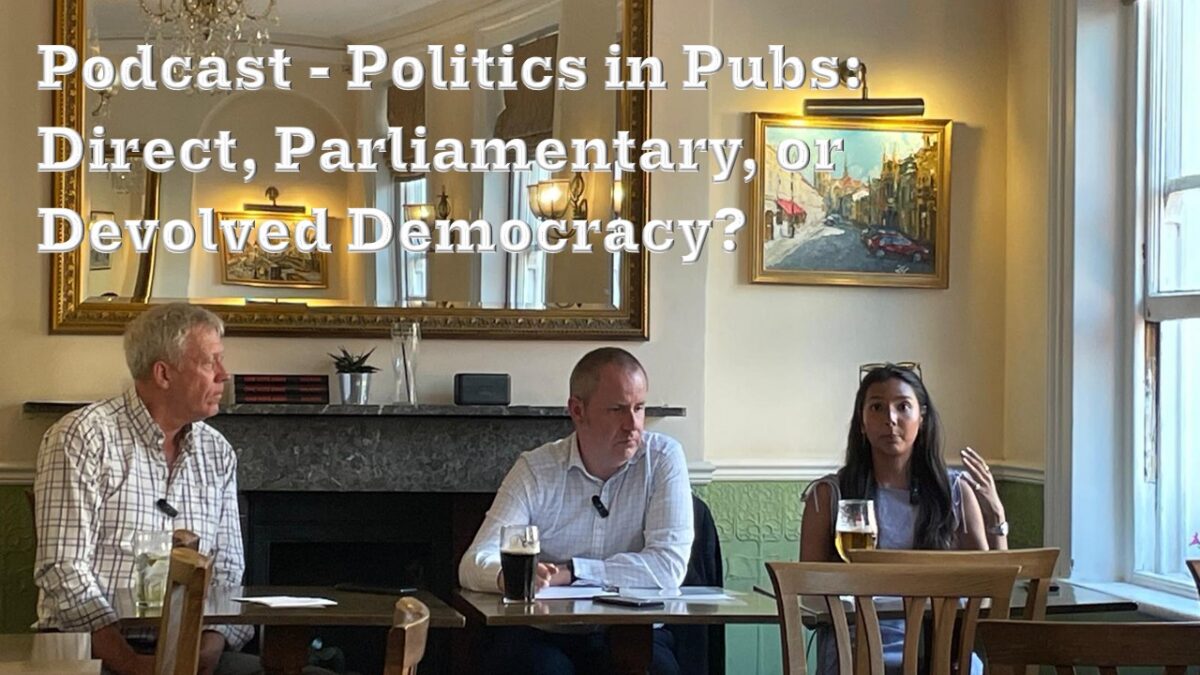
At the Politics in Pubs Central London event we were joined by Neil Petrie of The Direct Democracy Movement and Joanna Marchong, the new Senior Analyst and Head of Campaigns at Onward for a lively debate about the best form of democracy. https://politicsinpubs.org.uk/.
You can find more about The Direct Democracy Movement at https://ddrightnow.com/, including details of books https://ddrightnow.com/books and videos https://ddrightnow.com/videos on the subject. Neil Petrie can be found on X at https://x.com/PetrieNeil35553.
Onward aim to set the agenda on the right, researching and creating policies to solve the problems that are making the UK poorer, the public disillusioned, and the state less effective. They can be found at https://ukonward.com/, and on Facebook and X. Joanna Marchong can also be found on X at https://x.com/marchong_joanna.
Visit Politics in Pubs at https://politicsinpubs.org.uk/ for more on their events in London and beyond. We also have a brief write up of this event below.
The Swiss model or the drawbacks we’ve seen? – Politics in Pubs in London
Against a backdrop of frequent changes of prime minister, no party polling above ~30%, rising government debt, and talk of devolution. We had two main speakers:
- Neil Petrie (Direct Democracy Movement / board member), who strongly favours a Swiss-style semi-direct democracy.
- Joanna Marchong (Senior Analyst and Head of Campaigns at the Onward think tank), who is more sceptical of how devolution has worked in the UK and highlighted accountability problems.
Neil Petrie’s main points:
- The UK’s pure parliamentary/representative system is fundamentally flawed and “corrupt from the outset.” He described party whips as a “handling operation” (historically called the patronage secretary) that keeps MPs in line via patronage, with leaders themselves controlled by backers. Voters rarely feel heard.
- Neil advocated the Swiss model (in place since 1848): a mix of representative parliament plus citizen rights to force referendums. He summarises it as the “0-1-2 system”:
- Mandatory referendums for constitutional changes.
- 1% of voters can trigger a referendum on new legislation.
- 2% can launch a popular initiative (propose new ideas themselves).
- Referendums happen several times a year (national and local). Decision-making is pushed down via subsidiarity (to cantons and communities) where possible; major issues like defence stay federal.
- Switzerland has far lower debt-to-GDP (<40% vs UK >100%), people control the purse strings and therefore spend more carefully than politicians, and the country uniquely has nuclear shelters for its entire population (~9 million). He references US state-level initiatives (e.g. California) and the book Let the People Rule as supporting evidence that voters are more fiscally responsible than legislators.
- Brexit was a rare positive example of (limited) direct democracy. He has long supported the idea (via the Referendum Party, UKIP, etc.) and notes Nigel Farage has praised the Swiss system.
Joanna Marchong’s main points:
- Joanna agrees trust in politics and turnout are at historic lows and that people want to feel heard, but argues that simply moving power closer to people (devolution or more referendums) does not automatically improve outcomes.
- UK devolution evidence is poor after 25 years in Scotland and Wales:
- Scottish education was among Europe’s best in 1999; maths scores are now below the England average and at OECD levels.
- Crime remains high; drug deaths are far worse than the European average (roughly four times the level when Trainspotting came out).
- A&E waiting times that are linked to hundreds of avoidable deaths per year.
- Per-capita funding has been higher than in England, yet results have deteriorated.
- True devolution requires both the power to spend and full accountability for failure (no automatic Westminster bailouts). Many current UK metro-mayor and council arrangements lack this; some (e.g. Andy Burnham in Greater Manchester) have delivered visible successes such as bus fares, while newer or less experienced ones struggle with budgets, ring-fenced spending, social care, SEND, etc. Examples of heavily indebted councils (Birmingham and others) illustrate the problem.
- Referendums have drawbacks: they “unbundle” issues that should be traded off together (e.g. “more NHS spending?” gets a yes; “higher taxes?” gets a no). Simple binary questions ignore complexity and can lock governments into conflicting mandates for years (as seen in California). Parliament’s job, done properly, is to package competing public preferences into coherent budgets and policy. The current system fails at this, which is why people demand referendums, but switching wholesale risks worse outcomes.
- Cultural and institutional differences mean Swiss or US models do not transplant easily to the UK. Any serious devolution needs stronger local capacity, genuine fiscal responsibility, and clearer national-local boundaries.
The discussion was lively and civil. Neil repeatedly stresses that giving citizens veto/initiative power produces more sensible, lower-debt outcomes. Joanna repeatedly stresses evidence of under-performance under existing UK devolution and the practical difficulties of pure direct democracy. We took a short break for drinks, followed by an audience Q&A.