
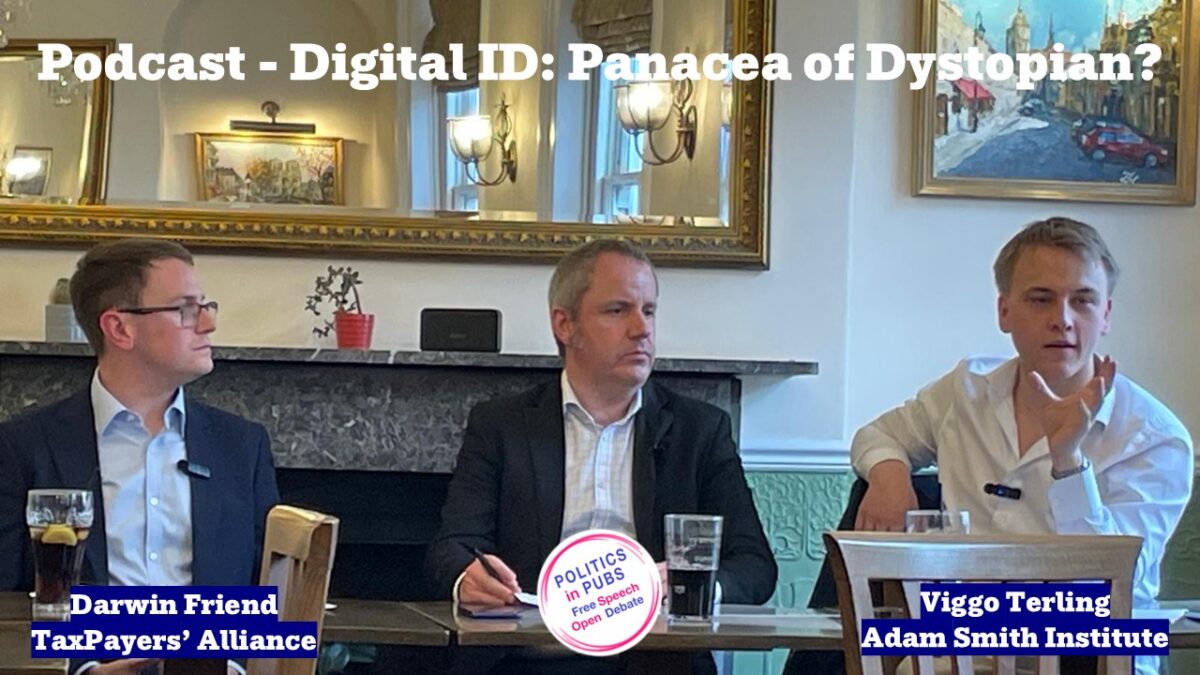
At the Politics in Pubs Central London event we were joined by Viggo Terling of the Adam Smith Institute, and Darwin Friend of the TaxPayers’ Alliance, for a discussion about Digital ID and whether it will prove to be a panacea or a dystopia, and what if anything we can do about it.
Visit Politics in Pubs at https://politicsinpubs.org.uk/ for more on their events in London and beyond. We also have a brief write up of this event below.
Mixed Panacea and Dystopia: Digital ID – Politics in Pubs in London
The discussion centred on whether a UK digital ID system would be a productivity-boosting modernisation or a costly, trust-eroding government overreach. The timing of the event allowed it to be framed against the day’s news of the proposed under-16 social media ban (requiring age verification) and broader concerns about data, trust, and liberty.
Viggo Terling was broadly supportive of well-designed digital ID, strongly prefers private-sector model. He strongly criticised the government’s nanny-state tendencies (e.g., the under-16 ban) but sees huge potential in digital verification. Viggo advocated the Swedish BankID model, created and funded by banks (not taxpayers), voluntary but near-universally adopted (~99% of adults), used for signing mortgages, loans, government services, etc., via facial scan on a phone or card.
Darwin Friend was sceptical, especially of government-led schemes. He opposes mandatory or government-run digital ID due to broken public trust, history of failed projects, and cost overruns. Darwin noted past ID card scheme under Blair wasted £4.6 billion before being scrapped. Darwin also identified the under-16 social media ban + age verification as a “slippery slope”/precursor to broader digital ID and data consolidation.
Both strongly agreed private-sector, voluntary systems are preferable and that data privacy, cybersecurity, and operational security are real issues.
Darwin’s advice for opponents: Arm yourself with facts (e.g., Big Brother Watch), resist publicly, support parties opposing it, and keep making the case. Viggo advised people to be proactive, lobby to improve the design rather than just oppose. Focus on benefits (productivity, convenience) alongside risks.
We have a civil, thoughtful debate between two broadly libertarian-leaning speakers. Both highlighted that how digital ID is implemented (government vs private, mandatory vs voluntary) matters far more than whether it exists in principle. The event ended with audience Q&A after a break.