
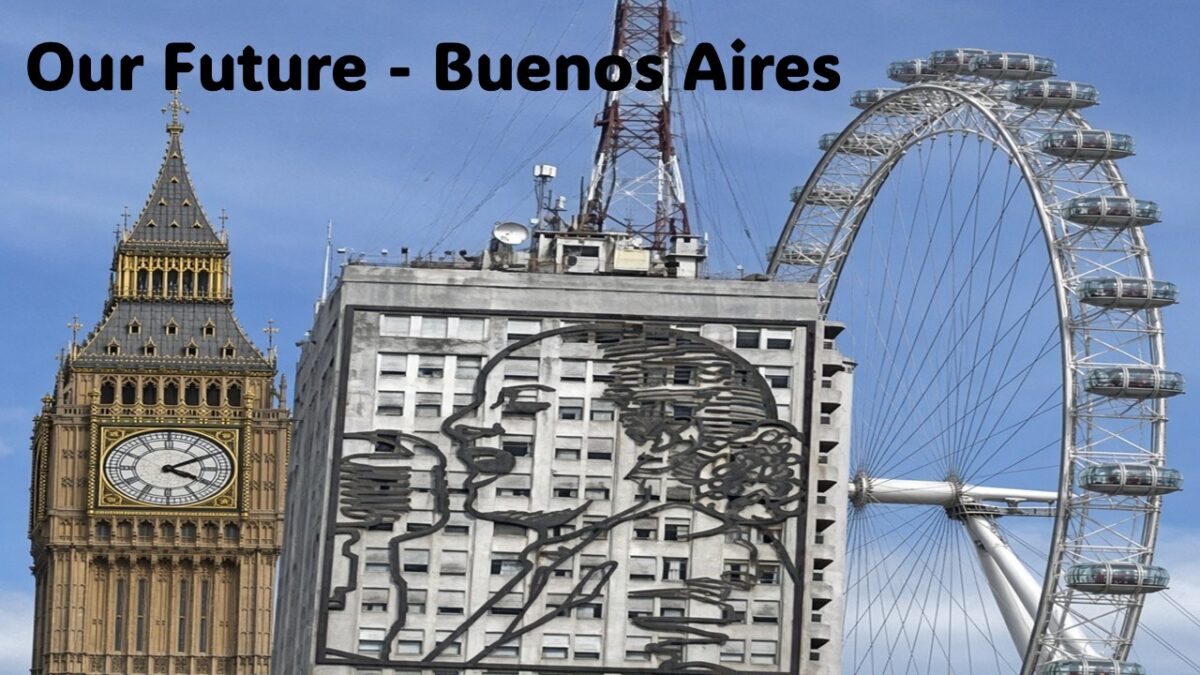
At our My tuppenceworth evening on the 9th November Mike Swadling spoke about how London’s future might be Buenos Aires.
“I saw a city that I felt had given up, lost hope: a city with its best days firmly behind it. I fear that is London’s, indeed the UK’s, future”
Headlines on the recent budget could have been written before a word was spoken in the House of Commons. Everyone expected a do-nothing budget and weren’t disappointed. This would have been fine, incredibly positive, in fact, if things were going well, but we all know they are not. At a time when we needed a barnstormer of a budget, we got a 0-0 draw on an overcast night with heavy fog.
On a recent trip to Buenos Aires, I saw a city that I felt had given up, lost hope: a city with its best days firmly behind it. I fear that is London’s, indeed the UK’s, future.
“Beef in all forms was plentiful, and there was a good selection of white, blush and red wines. The support for and culture around their football teams was amazing”
Before I’m too harsh on the city, I should mention some of the highlights. Politeness and decency abound, as do people often dressed in a classic, chic style. Beef in all forms was plentiful, and there was a good selection of white, blush and red wines. The support for and culture around their football teams was amazing, as was the stunning Estadio Tomás Adolfo Ducó, the art deco home ground of Huracán.
But herein lies the problem. It was an original 1940s art deco stadium. It wasn’t a museum piece; it was still very much being used, and it, like much of the city, was old. They say you can tell a lot about a city by the number of cranes in the sky. For Buenos Aires, this doesn’t bode well.
Whole streets in the city look like the sets of classic movies. Some of this is good, preserved architecture, but most of it is just very old, tired buildings. But it goes beyond buildings. I noticed a lack of youngsters, not entirely unusual in a city centre, but a quick search later suggested a deeper problem. Argentina’s fertility rate has fallen by roughly 47% over the past decade, to an average of 1.23 children per woman. By comparison, the UK fertility rate is at a historic low of 1.39.
“the incentive to save and invest must still be difficult when your money loses a quarter of its value each year and only a few years ago was losing two-thirds annually”
And now my reason for speaking. I fear that in visiting Buenos Aires, a dated city, I might in many ways have been looking at London’s future.
Around 1900 Argentina was said to be the richest country in the world. Today Argentina’s GDP per capita is about $14,900. That compares with the UK at about $61,056. It puts Argentina on a similar level to China and Mauritius, and lower than most of its neighbours.
President Javier Milei’s libertarian policies have produced improvements. Inflation is still around 32% but down from 211% when he took office. In 2025 they posted their first fiscal surplus since 2008, and the official poverty rate is the lowest since 2018. Despite this, the incentive to save and invest must still be difficult when your money loses a quarter of its value each year and only a few years ago was losing two-thirds annually.
Whilst the country has had government stability for some years, coups d’état in 1930, 1943, 1955, 1962, 1966, 1976 and 1981 leave a long shadow. Government buildings have a heavy police presence, and water cannons, granted looking fairly unused, are still parked near many major buildings.
There is pride in Argentina, but I felt a lack of purpose. National flags abounded in the capital. There was no shortage of references to Eva Perón; but the other most revered national figures appeared to be Diego Maradona and Lionel Messi. Is this enough?
I asked a guide on a tour I was taking, something I had always wondered: why Argentina is separate from the other Spanish speaking countries in South America. Why are they not just one large country? She described them as city-states that became countries, indeed Montevideo and Uruguay across the River Plate is exactly that, but this rather points to a lack of unifying national story.
“I’m not saying this to apportion any blame, but rather to note they seemed to lack a sense on agency in their own lives”
Beyond that the tour often referenced how those dastardly Europeans had done things to the people of Argentina. How they had been colonised. I note the tour guide, and tourists appeared to very much be of European heritage. They were born generations after the events described yet somehow felt victims to events likely perpetrated by their ancestors. I’m not saying this to apportion any blame, but rather to note they seemed to lack a sense on agency in their own lives.
Now Argentina is not the UK in many, many ways. But what do we see:
- Economic stagnation, with high inflation
- Government instability and a lack of incentives to invest
- The veneration of victimhood
- A lack of unifying national story and largely superficial figures revered
- A collapsing birthrate.
Does any of this sound familiar?
Now there a lot good about the place, so good I went on holiday there. But I did see a city with a sense its best days were behind it. Buenos Aires has a beigeness to it. Something I increasingly see in London, and not what I want for our great capital.
I’m not sure I see how we escape the path we are on, but I do think I may have glimpsed the journeys destination.
“Buenos Aires has a beigeness to it. Something I increasingly see in London, and not what I want for our great capital”