Surveillance State – Live Facial Recognition

” the idea that mass scanning of faces in public should become routine ought to alarm anyone who values freedom over convenience”

The Metropolitan Police are proposing a major expansion of live facial-recognition surveillance across London, claiming success after nearly a thousand arrests linked to the technology. Their public consultation, proudly cited by the force, apparently found that 85% of respondents support the use of facial recognition to catch serious criminals.

On the surface, it sounds persuasive – a high-tech answer to crime. But the idea that mass scanning of faces in public should become routine ought to alarm anyone who values freedom over convenience. Let’s not forget that it is little coincidence that facial recognition is being rolled out in tandem with digital ID – the two systems will surely be linked, meaning walking down the high street to get a pint of milk becomes the equivalent of walking through passport control.

In a free society, the presumption of innocence is not negotiable. Yet facial-recognition systems function by presuming the opposite: that everyone passing a camera deserves to be checked against a criminal database. The innocent are monitored not because of what they’ve done, but because they exist in public. That logic turns civic life into a police line-up and erodes one of the oldest protections in liberal civilisation – that the citizen need not justify their innocence to The State.

“In a free society, the presumption of innocence is not negotiable. Yet facial-recognition systems function by presuming the opposite”

Proponents point to reassuring statistics: the Metropolitan Police claim a false-match rate of just 0.0003 % from millions of scans. But even such a tiny error, multiplied across a city of millions, produces hundreds of wrongful alerts and unjustified interventions. More troubling still, eight in ten false matches involved black individuals, underscoring that algorithmic bias is not a theoretical risk but a measurable injustice. To shrug off these flaws because the “majority supports the policy” is to forget that liberty is not subject to opinion polls.

Beyond the technical debates lies a deeper constitutional one: who authorises this surveillance, and who restrains its use once normalised? There was no vote in parliament, no consultation when 46 million of our passport photos were uploaded to a database under the last Conservative government. Without strict legal boundaries and independent oversight, any promise of restraint will vanish under the pressure of convenience. History shows that powers granted to police in the name of safety are rarely surrendered voluntarily.

“who authorises this surveillance, and who restrains its use once normalised?”

The state’s duty to protect citizens does not extend to treating every citizen as a potential suspect. For libertarians, that principle defines the moral boundary of government. A society that trades privacy for marginal gains in policing may find that it loses both — liberty first, and trust soon after.

In the end, the expansion of facial-recognition surveillance is not progress – it is the dismantling of the presumption of innocence, one scan at a time.

Alex Zychowski – Libertarian Party UK

You can learn more about the Libertarian party at https://libertarianpartyuk.com/, follow Alex on X/ Twitter @alexzychowski or email him at alex.zychowski@libertarianpartyuk.com.

Originally posted on 4th November at https://www.facebook.com/share/p/17cc8Hmbye/?mibextid=wwXIfr

Main image from Grok.
Live Facial Recognition – A nightmare for criminals or for freedom?

By Mike Swadling

Trials are underway across the country of Live Facial Recognition technology allowing Police to scan crowds for known criminals.  These trials have taken place in Croydon town centre among other places.  The MP just across the border in Croydon South is Chris Philp the Minister of State for Crime, Policing and Fire, and my local MP wrote to residents about the trials.

Chris’ note describes how the software works.

“LFR starts with a “watchlist” of images of people who are wanted for serious offences or who are wanted by the Court for failing to attend a criminal hearing. A camera is then set up by Police in a location with high footfall, and advanced facial recognition software is used to see if anyone walking past matches one of the images on the watchlist”

“I admit to having been in some conflict, not losing too much sleep over the criminal arrests, but worrying of the civil liberty implications”

According to a Croydon Guardian article of the 10th February, the software has led to 45 arrests.  As someone who has seen the sharp increase in crime in Croydon, and people staying away from the town centre in recent years, what’s not to like? Well…

A couple of friends recently ask my thoughts on the civil liberties implications and if it is just an extension of CCTV cameras everywhere.  I admit to having been in some conflict, not losing too much sleep over the criminal arrests, but worrying of the civil liberty implications and how the technology might be used in the future. 

“Is it the same as a Police Officer walking down the street and recognising a known criminal or is it more like a house search?”

The obvious point with any new technology is once we have it, we can’t uninvent it.  Whishing it would go away isn’t realistic, so the best option is to work out how we use it.  How to use Live Facial Recognition?  I believe we should look at how we police today and see what template the technology best fits into.  Is it the same as a Police Officer walking down the street and recognising a known criminal or is it more like a house search?

We have templates for these.  In the case of a Police officer recognising you in the street, to arrest you they must meet the following criteria.

“To arrest you the police need reasonable grounds to suspect you’re involved in a crime for which your arrest is necessary. The police have powers to arrest you anywhere and at any time, including on the street, at home or at work.

Whereas the power to search your house (although with some time specific exceptions), requires additional judicial sign-off.

If the police want to search a property, they must usually get a search warrant from the court first. In the application, the police must prove to the court that there are reasonable grounds for the warrant.”

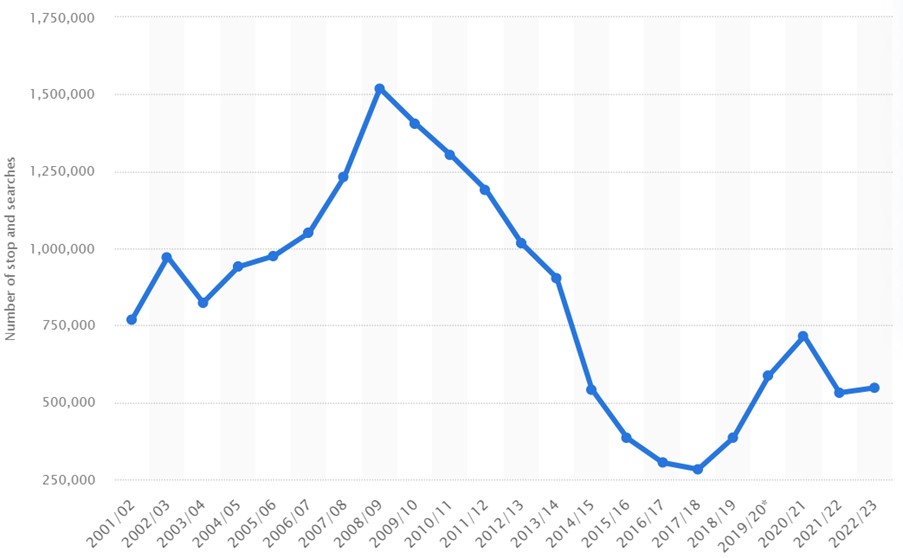
Stop and Search powers lie somewhere in between these.  The interpretation of the law changes and the way stop and search has been carried out in recent years, has seen wildly varying numbers of searches.

Number of stop and searches performed by the police in England and Wales from 2001/02 to 2022/23

Source: https://www.statista.com/statistics/284599/police-pace-stop-and-searches-in-england-and-wales/

Likewise in the UK wiretapping requires judicial approval.

“Without a warrant, the police cannot listen to a person’s phone conversations, unless one of the parties to a phone conversation consents to the use of a wiretap. Any information they gather without a warrant and without consent cannot be used against a defendant in a criminal trial.”

“scanning peoples faces to see if they match a watchlist goes a significant step further than seeing you acting suspiciously”

So where does Live Facial Recognition fit within these templates.  Clearly this is a matter of opinion, but it does seem to me that scanning peoples faces to see if they match a watchlist goes a significant step further than seeing you acting suspiciously or having reasonable grounds to suspect you’re involved in a crime. 

As a general view it seems the use of Live Facial Recognition is more akin to a search.  Therefore, if it is used in the street a judge should be needed to sign it off for a specific purpose.  Examples could be, Police think there will be trouble at a specific football match, and it is used to search only for known football hooligans, or there has been increased gang violence in an area and it is used to search only for known gang members wanted for crimes.  This would mean not giving Police the power to just use the technology in a given high street on the off chance that they can arrest some people. 

However, it does seem reasonable that it is used in some places you would expect Police to act.  This could be in Police stations to identify suspects, in courts, at the border, where you should be carrying a passport already, the systems could permanently run.

“we should panic, a bit, not overly so, but it is reasonable to assume the Police will abuse this power without some constraint”

What about all the criminals that won’t be caught?  Chief Superintendent Andy Brittain, is quoted to have said people “don’t need to panic”.  In the last couple of weeks we have seen police tell a “Christian singer on Oxford Street that she is ‘not allowed’ to perform ‘church songs outside of church grounds’”, only a few years ago police had to “ apologise for telling family they weren’t allowed in their own front garden”, whilst elsewhere there were using drones to “chase Peak District ramblers”.  Police have in recent times treated different groups protesting in central London very differently, so much so that the then Home Secretary Suella Braverman wrote as summarised in Spiked that the “Metropolitan Police must be ‘even-handed’ in their approach to protests. She warned that there is now a ‘perception that senior police officers play favourites’”.  In short, yes we should panic, a bit, not overly so, but it is reasonable to assume the Police will abuse this power without some constraint.

We don’t today allow police to search people without cause, search homes or wiretap without a warrant, we restrain police powers to protect our freedoms, and there is no reason why Live Facial Recognition should be any different.

Source: Uploaded a work by mikemacmarketing from https://www.flickr.com/photos/152824664@N07/30188201497/ with Upload Wizard