Surveillance State – Live Facial Recognition

” the idea that mass scanning of faces in public should become routine ought to alarm anyone who values freedom over convenience”

The Metropolitan Police are proposing a major expansion of live facial-recognition surveillance across London, claiming success after nearly a thousand arrests linked to the technology. Their public consultation, proudly cited by the force, apparently found that 85% of respondents support the use of facial recognition to catch serious criminals.

On the surface, it sounds persuasive – a high-tech answer to crime. But the idea that mass scanning of faces in public should become routine ought to alarm anyone who values freedom over convenience. Let’s not forget that it is little coincidence that facial recognition is being rolled out in tandem with digital ID – the two systems will surely be linked, meaning walking down the high street to get a pint of milk becomes the equivalent of walking through passport control.

In a free society, the presumption of innocence is not negotiable. Yet facial-recognition systems function by presuming the opposite: that everyone passing a camera deserves to be checked against a criminal database. The innocent are monitored not because of what they’ve done, but because they exist in public. That logic turns civic life into a police line-up and erodes one of the oldest protections in liberal civilisation – that the citizen need not justify their innocence to The State.

“In a free society, the presumption of innocence is not negotiable. Yet facial-recognition systems function by presuming the opposite”

Proponents point to reassuring statistics: the Metropolitan Police claim a false-match rate of just 0.0003 % from millions of scans. But even such a tiny error, multiplied across a city of millions, produces hundreds of wrongful alerts and unjustified interventions. More troubling still, eight in ten false matches involved black individuals, underscoring that algorithmic bias is not a theoretical risk but a measurable injustice. To shrug off these flaws because the “majority supports the policy” is to forget that liberty is not subject to opinion polls.

Beyond the technical debates lies a deeper constitutional one: who authorises this surveillance, and who restrains its use once normalised? There was no vote in parliament, no consultation when 46 million of our passport photos were uploaded to a database under the last Conservative government. Without strict legal boundaries and independent oversight, any promise of restraint will vanish under the pressure of convenience. History shows that powers granted to police in the name of safety are rarely surrendered voluntarily.

“who authorises this surveillance, and who restrains its use once normalised?”

The state’s duty to protect citizens does not extend to treating every citizen as a potential suspect. For libertarians, that principle defines the moral boundary of government. A society that trades privacy for marginal gains in policing may find that it loses both — liberty first, and trust soon after.

In the end, the expansion of facial-recognition surveillance is not progress – it is the dismantling of the presumption of innocence, one scan at a time.

Alex Zychowski – Libertarian Party UK

You can learn more about the Libertarian party at https://libertarianpartyuk.com/, follow Alex on X/ Twitter @alexzychowski or email him at alex.zychowski@libertarianpartyuk.com.

Originally posted on 4th November at https://www.facebook.com/share/p/17cc8Hmbye/?mibextid=wwXIfr

Main image from Grok.

Liberal Democrats ‘protection’ of individual rights

“The hypocrisy is glaring. Digital ID represents one of the clearest threats to individual liberty in the modern era”

Ed Davey took to the stage at the Liberal Democrat conference last week, waxing lyrical about “British values” – citing tolerance, decency, the rule of law, and individual liberty. Yet this sermon on freedom comes in the very same week his party proposed dropping their opposition to a national Digital ID system.

The hypocrisy is glaring. Digital ID represents one of the clearest threats to individual liberty in the modern era: an infrastructure for surveillance, centralised control, and the slow erosion of personal privacy. To champion “freedom” while embracing such tools of state power is not just inconsistent: it is dishonest.

The mask has slipped. The Liberal Democrats, once a party that at least paid lip service to civil liberties, now line up with Labour and the Conservatives in offering nothing but different shades of the same statist authoritarianism. The rhetoric may differ, but the trajectory is the same – more control, less autonomy.

“To champion “freedom” while embracing such tools of state power is not just inconsistent: it is dishonest”

British values worth defending are not found in empty speeches but in the daily protection of individual rights against encroaching state power. Davey’s words ring hollow.

Alex Zychowski – Libertarian Party UK

You can learn more about the Libertarian party at https://libertarianpartyuk.com/.

Originally posted on 24th September at https://www.facebook.com/share/p/1CdviDEubv/

Main image from By Keith Edkins – Own work, CC BY-SA 3.0, https://commons.wikimedia.org/w/index.php?curid=62761419

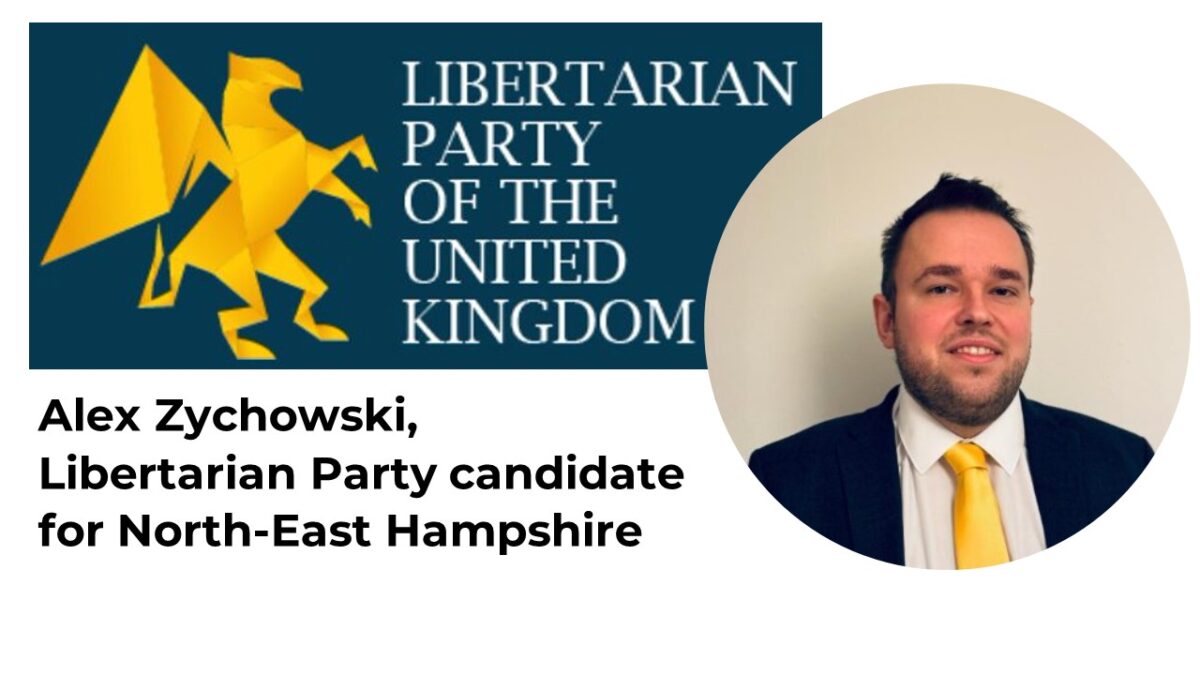
Alex Zychowski, Libertarian Party candidate for North-East Hampshire

Alex Zychowski is the Libertarian Party Prospective Parliamentary Candidate for North-East Hampshire.  We spoke with Alex about his decision to stand.

“the State’s hideous response to the Covid-19 pandemic finally removed any doubt about the dangers we face and the immediate need for action”

Can you briefly introduce yourself to our readers?

I am a teacher living in Hampshire. Besides politics, my interests include country walks, football and reading. I was born in London and am of Polish descent.

What made you decide to stand for the Libertarian Party?

In recent years individual liberty has become increasingly under threat, not just from our politicians but from advances in surveillance technology and censorship of speech online. For me, the State’s hideous response to the Covid-19 pandemic finally removed any doubt about the dangers we face and the immediate need for action. This is why I have decided to stand as a candidate for the Libertarian Party.

“it is of vital importance to preserve the rural character of the constituency”

You’re the Spokesman for North-East Hampshire what’s made you decide to represent this area?

I have made my home in North-East Hampshire and have fallen completely in love with the peace and nature that can be found here. As such I oppose housing developments that have been forced upon local residents by central government’s poor planning.

“the Hampshire Constabulary’s recent trialling of retrospective facial recognition technology such Orwellian tools can be afforded no place here”

What do you see as the big concerns for the constituency and what issues do you hope to champion?

As mentioned above it is of vital importance to preserve the rural character of the constituency. This involves not only opposing the mass construction of low-quality new build housing estates, but maintaining the vitality of our waterways.

I note that the incumbent in North-East Hampshire has twice voted in favour of lockdown restrictions. Such treason against the individual cannot go unpunished at the ballot box. Perhaps of even greater concern is the Hampshire Constabulary’s recent trialling of retrospective facial recognition technology such Orwellian tools can be afforded no place here.

For those eager to help, how can they get involved in the campaign?

You can find out more about the Libertarian Party at https://libertarianpartyuk.com/ and find my announcement article at https://libertarianpartyuk.com/ne-hampshire-ppc-announced/.

You can also follow me on Twitter @alexzychowski or email me at alex.zychowski@libertarianpartyuk.com.